
In [Part 1 of this series], I established that the “Cloud” isn’t some magical, weightless entity floating gracefully in the ether. It’s a brutal, physical manifestation of heavy concrete and hungry silicon that’s currently draining the electrical power equivalent of a medium-sized town every single time a new facility spins up, and I broke down the 9% utility hikes that local ratepayers are forced to foot. I dissected the absurdity of plugging gigawatt-scale AI infrastructure into a 1950s residential power grid.
Electricity is only half of this parasitic equation.
If you want to understand the true localized cost of the AI revolution, you’ve got to look at your quarterly water bill. Because right now, the tech industry is literally boiling your municipal drinking water into the atmosphere, and they’re doing it simply because they don’t want to pay for modern plumbing. It’s an absurd, intellectually bankrupt thermal strategy.
The Physics of the Desk Fan
Thermodynamics doesn’t care about marketing decks.
When you pack tens of thousands of high-performance GPUs into a single room to train a Large Language Model, you aren’t just processing data; you’re generating an apocalyptic amount of heat. A modern AI server rack draws anywhere from 40 to 100 kilowatts of continuous power. A massive, power-hungry beast that highlights how primitive our hardware scaling remains.
Blowing chilled air over a row of high-density AI server racks drawing a flat-line 100 kilowatts of continuous power is like trying to cool a roaring jet engine with a cheap plastic desk fan. It’s a thermodynamic dead end because air simply lacks the specific heat capacity required to pull that much thermal energy away from the silicon before the chips melt into expensive puddles of slag. The physics of traditional air cooling has hit its density ceiling at high-kW loads.
So, how are the hyperscalers solving this? They’re cheating.
The Evaporative Subsidy
Instead of building a legitimate, closed-loop thermal containment system, they take millions of gallons of pristine, potable municipal drinking water. The exact same resource that families rely on for daily hygiene, and run it through open-loop cooling towers where the water absorbs server heat, boils into steam, and gets blasted straight into the atmosphere where it can never be recovered by the local reservoir. It’s a colossal, lazy waste of municipal resources.
It’s a one-way trip. They aren’t even attempting basic vapor reclamation through external heat exchangers to capture and recycle the condensation. That water doesn’t return to the local reservoir. It’s just gone.
A single, moderately sized data center can consume anywhere from 1 to 5 million gallons of clean water per day. An egregious, intellectually bankrupt waste of municipal resources. In places like Loudoun County, Virginia, where over 70% of the world’s internet traffic routes through these sterile concrete boxes, the sheer volume of water being sacrificed to keep Facebook and Google servers from melting is absurd.
Why do they do this? Because water’s dirt cheap, and local governments are practically giving it away to attract tech giants. Evaporative cooling keeps the hyperscalers’ Capital Expenditures (CapEx) artificially low. They’re socializing the environmental and infrastructural cost of their thermal mismanagement onto the local taxpayer.
When your local reservoir drops and your quarterly water bill spikes, you’re subsidizing their profit margin.
The Dielectric Mandate
I don’t believe local communities have to accept this. The engineering solution already exists, and it’s elegant, efficient, and achieves a dramatically reduced municipal water dependency.
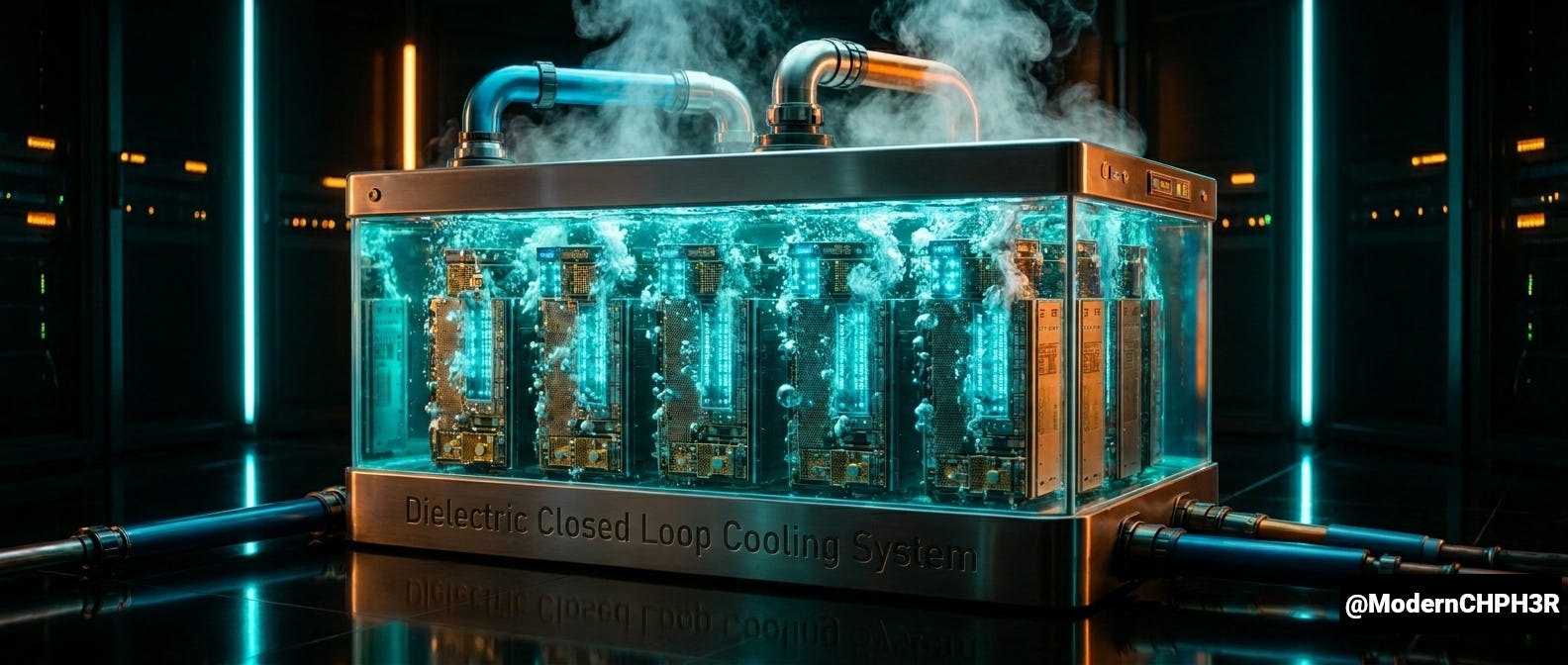
It’s called Closed-Loop Dielectric Fluid Immersion.
By submerging the entire, naked server board directly into a bath of synthetic, non-conductive dielectric fluid, the heat is absorbed instantly at the silicon level as the liquid boils at a low temperature, rises as vapor, hits a sealed condenser coil, and falls right back into the tank as a liquid, re-utilizing the exact same fluid indefinitely without consuming a single drop of local municipal water. It’s exponentially more efficient than air cooling, and it allows for much higher compute density.
So why isn’t every data center using it? Because retrofitting a facility for dielectric immersion increases the initial construction CapEx by roughly 25%.
The trillion-dollar tech monopolies have decided that their balance sheets are more important than your local watershed. They’d rather boil your drinking water than pay for the fluid.
This is an architectural failure driven entirely by corporate greed and bureaucratic inertia. Local zoning boards continue to approve these massive concrete parasites without demanding modern thermal accountability, hiding behind legacy land-use loopholes and “by-right” zoning categories they quietly rubber-stamped decades ago without ever understanding the future resource drain.
It’s time to stop begging for corporate sustainability reports and start dropping the hammer. Local governments must institute an immediate zoning moratorium on all new data centers until closed-loop dielectric immersion cooling is codified into law. If you want to build an AI facility in my county, you buy the fluid. You don’t get to boil my local drinking water.
In Part 3: Bring Your Own Power, I’ll look at why plugging gigawatt compute clusters into a public grid is a recipe for blackouts, and why hyperscalers must be mandated to build their own micro-reactors.
The ModernCYPH3R Infrastructure Glossary
A No-Fluff Translation of Tech Jargon for all of us
If you want to cut through the corporate sustainability theater and public-relations spin surrounding the AI boom, you have to speak the language. Here is a direct, cynical translation of the technical and bureaucratic jargon dominating the data center debate, written for the average citizen who doesn’t want to watch their water bill double to fund a tech monopoly’s cooling bill.
1. BYOP (Bring Your Own Power)
The Jargon: Off-grid microgrid generation for mission-critical digital infrastructure.
The Reality: Generating your own electricity on-site instead of plugging directly into the public utility grid like a parasite. Think of it as putting a mini-nuclear reactor or industrial fuel cells in your parking lot because you know the local power company’s ancient transformers will literally melt if you try to spin up another cluster of AI chips.
2. “By-Right” Zoning
The Jargon: Non-discretionary development conforming fully to pre-existing land-use designations.
The Reality: A bureaucratic cheat code that lets developers bypass public hearings, environmental impact reviews, and county votes entirely. Because this decades-old, rubber-stamped land-use designation pre-approves specific industrial projects without requiring discretionary county oversight, local zoning boards find themselves legally bound to approve massive, energy-devouring AI installations, even when those sterile concrete fortresses threaten to completely exhaust the local residential power grid and drain the county’s pristine municipal drinking reservoirs dry in the middle of a summer drought.
3. Closed-Loop Dielectric Fluid Immersion Cooling
The Jargon: Two-phase liquid immersion thermal management for high-density compute clusters.
The Reality: Instead of relying on the primitive, brute-force method of blowing chilled air across rows of molten-hot silicon chips using cheap plastic fans, this elegant engineering system submerges entire naked server boards directly into a bath of synthetic, non-conductive fluid that absorbs heat instantly at the chip level, re-utilizing the exact same liquid indefinitely without consuming a single drop of municipal drinking water.
4. GPU (Graphics Processing Unit)
The Jargon: Parallel-processing accelerator for deep learning workloads.
The Reality: A hyper-specialized microchip designed to perform millions of complex mathematical calculations at the exact same time. Originally built to make video games look pretty, these hungry silicon beasts now serve as the structural muscle behind modern AI training, and they generate an apocalyptic amount of heat while doing it.
5. Open-Loop Evaporative Cooling
The Jargon: Economical adiabatic cooling using municipal utility infrastructure.
The Reality: A primitive, lazy thermal hack. Instead of paying a premium for closed-loop fluid systems, hyperscale data centers take millions of gallons of pristine, potable municipal drinking water directly from public reservoirs, run it over hot server heat-exchangers, boil it into steam, and blast it straight into the sky where it can never be recovered. This leaves local taxpayers to pick up the tab for depleted municipal water supplies. It’s the engineering equivalent of cooling your car engine with a garden hose and letting the water run down the sewer drain.
6. SMR (Small Modular Reactor)
The Jargon: Gen-IV modular fission technology for localized industrial baseload.
The Reality: A compact, factory-assembled nuclear reactor that delivers steady, carbon-free baseload electricity. Think of it as an enterprise-grade, factory-fabricated nuclear submarine engine parked directly in a data center’s back lot, delivering a continuous, unyielding stream of clean, carbon-free gigawatts to hungry AI processors without begging the local public utility grid for a single drop of juice or forcing struggling residential ratepayers to subsidize the transmission lines of a trillion-dollar tech monopoly.
7. Solid Oxide Fuel Cells
The Jargon: Electrochemical natural gas/hydrogen conversion for decentralized baseload.
The Reality: High-efficiency, fuel-flexible power generation modules that bypass combustion entirely to produce direct-current electricity. They use highly efficient, non-combustion electrochemical reactions to convert fuel, including natural gas, landfill biogas, and zero-carbon green hydrogen, directly into electricity. These utility-grade power pods, each roughly the size of a standard parking space, act as localized micro-power plants parked right outside the facility wall. This allows giants like Google, Pepsi, and FedEx to completely eliminate those filthy, noisy diesel generators that sit idling in parking lots. Those legacy systems are kept on standby purely to spew raw particulate matter into the local air shed. Regulators quietly rubber-stamp emergency pollution waivers for them whenever the public grid starts to collapse.

Copyright © 2017-2026 James McCabe | ModernCYPH3R. All rights reserved.
No part of this publication—including text, original data analysis, or visual assets—may be reproduced, distributed, or transmitted in any form or by any means, including electronic or mechanical methods, without including credit to the author. ModernCYPH3R and ModernCYPH3R.com are the exclusive intellectual property of JMc Associates, LLC.