
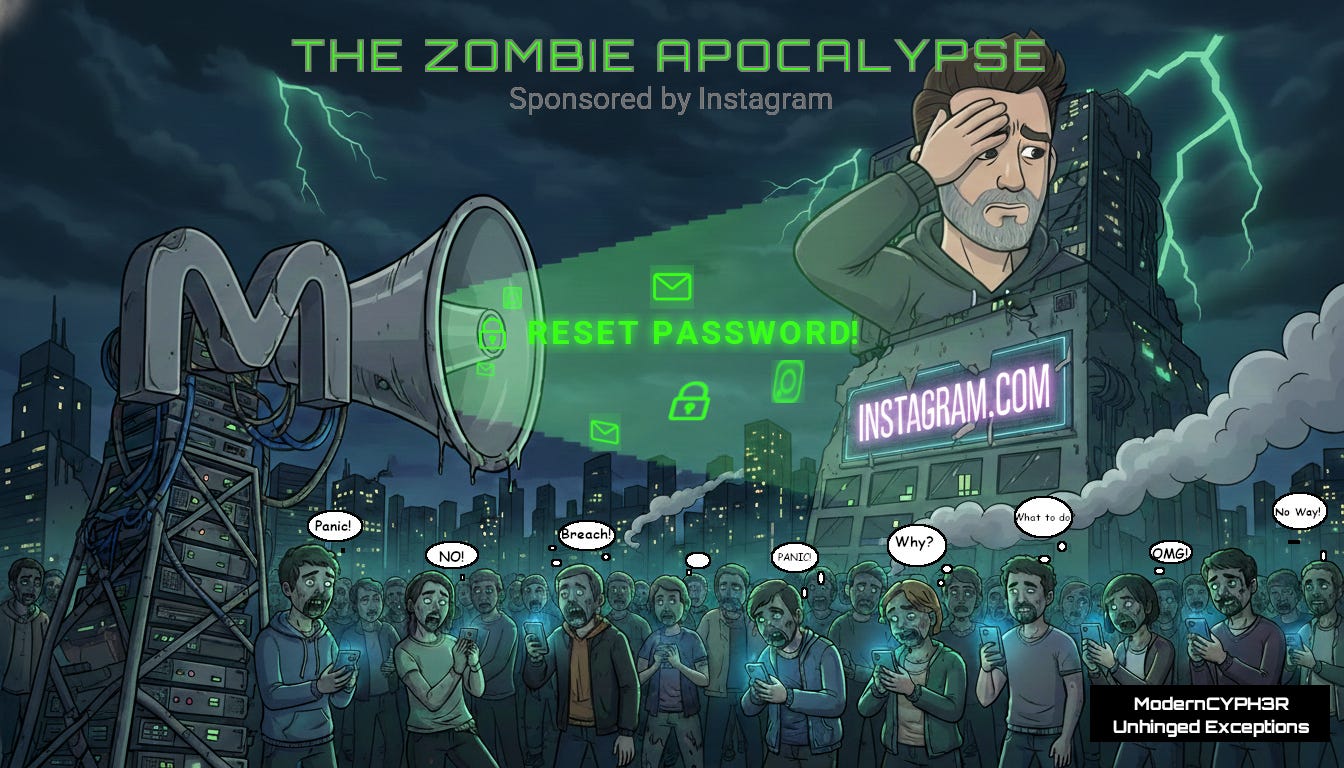
Last week, approximately 17 million people woke up to find that Instagram had sent them a very urgent, very official-looking password reset email. For most of us, receiving a security alert from Meta is like getting a letter from the IRS: even if you’ve done nothing wrong, you immediately start wondering if you can survive on a diet of prison oatmeal.
The internet, being a calm and rational place, immediately concluded that the digital end-times were upon us. Malwarebytes pointed to a “17.5 Million User Leak” on the dark web. Users panicked. Panic turned into chaos. Chaos turned into… well, mostly people complaining on X (formerly Twitter, currently a dumpster fire).
Meta eventually emerged from the shadows to say, “Relax! It wasn’t a breach. It was just an external party using a technical issue to send you those emails. We fixed it. Sorry for the confusion!”
This is like your local bank saying, “Good news! Nobody robbed the vault. We just accidentally left a giant megaphone on the sidewalk that allowed a random passerby to scream ‘THE VAULT IS EXPLODING’ into everyone’s living room at 4:00 AM. Our bad!”
The “Reset” Loop-de-Loop: Meta confirmed a bug allowed an outside party to mass-trigger these emails. In the world of Systems Architecture, we call this an Input Validation Failure, or more accurately, “Leaving the keys in the ignition with a sign that says ‘Please Don’t Drive Me’.” They built a frictionless recovery system—which is great for people who forget their passwords every three minutes—but they forgot the “Rate Limiting” part. If a system allows one person to ask for 17 million password resets in an hour, that’s not a feature; it’s a denial-of-service attack with better formatting.
The Zombie Data: That “17 Million” dataset? It’s what I call The Ghost in the Machine. Researchers found it’s actually a “Greatest Hits” compilation of API scrapes from 2017 and 2022. It’s recycled trash. A threat actor named “Solonik” basically took a bunch of old phone numbers and emails, put them in a new folder labeled “2024 LEAK,” and sold it to people who are clearly not as smart as they think they are.
The Meta-Physics of Trust: Meta’s defense is that “No breach occurred.” This is technically true in the same way that a ship isn’t “sinking” if the hull is intact but the captain is currently throwing all the lifeboats overboard for fun. If your official security domain—the one we are told to always trust—is being used as a megaphone for a spammer, the System has Failed. Trust is binary. Once you desync the narrative from the reality, you’re just running Security Theater with a really expensive ticket price.
We’ve entered a bizarre era of “Quantum Cybersecurity,” where a system is simultaneously secure and compromised until someone from PR observes it and issues a press release. To the user, the distinction is academic. If your inbox is screaming that your digital identity is on fire, it doesn’t matter if the fire was started by a master hacker or just a Meta intern who forgot to put a “Limit 1 per customer” sign on the password-reset button.
We are training the world to ignore security alerts because the systems behind them have become too noisy to trust. And when the “boy who cried wolf” is an automated API loop, eventually, the wolf just stops by for dinner and nobody bothers to look up from their phone.
Pro Tip: In the meantime, if you get a password reset email you didn’t ask for, just ignore it. Or, do what I do: put your phone in a drawer, go outside, and look at a real tree. Trees rarely experience API timeouts, and they almost never try to reset your password.