
The "Free Lunch" is Over
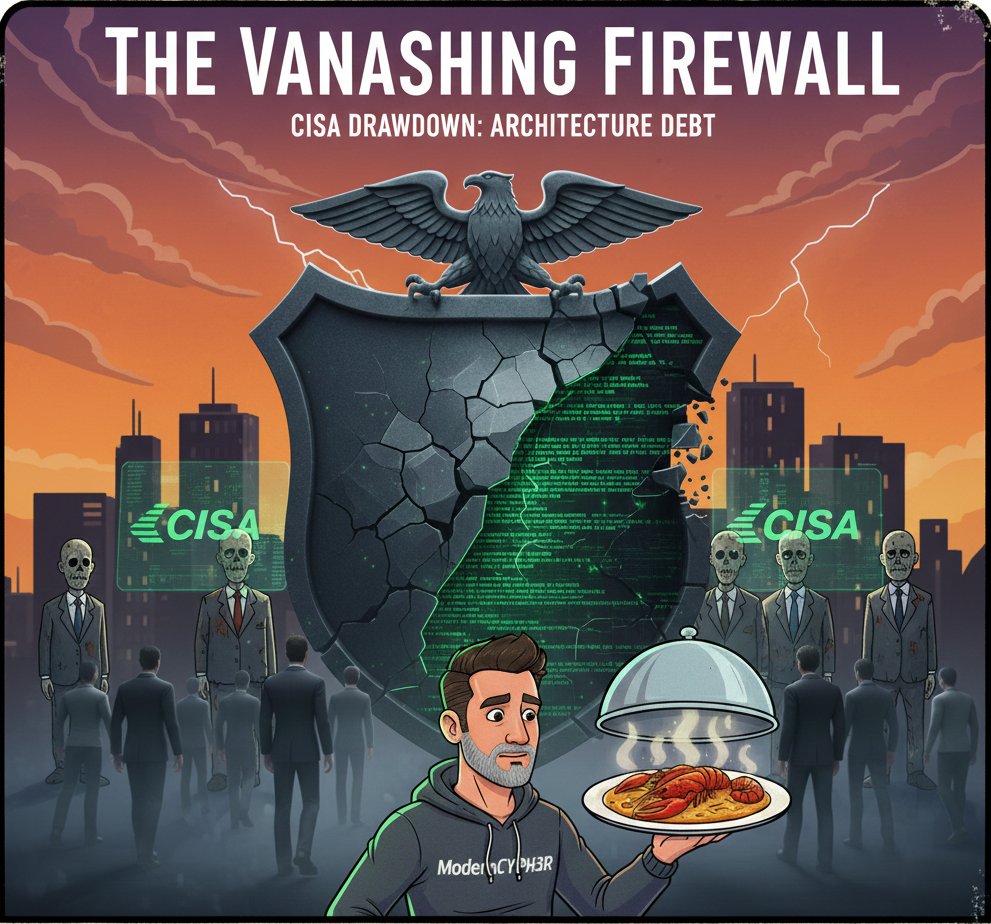
Hey Corporate America: You might want to know that the folks over at CISA have effectively shut their blinds. In my 30+ years of building and breaking networks, I’ve seen some spectacular "Security Theater," but nothing quite matches this federal logic fail. Imagine you’ve built a high-end restaurant, but you’ve decided that the local fire department is responsible for checking your ovens every night for free. Now, the fire department just laid off a third of its inspectors and told you, "Good luck with the grease fires."
That is exactly where we sit in early 2026.
For a decade, the C-Suite has treated CISA (Cybersecurity and Infrastructure Security Agency) as the national “Early Warning System.” We’ve baked their threat feeds, their “Shields Up” alerts, and their vulnerability disclosures into our enterprise risk models. We’ve used them as a crutch to justify lean internal security budgets.
Well, the crutch just snapped.
A 30% Logic Fail
The numbers for 2026 are a masterclass in “penny wise, pound foolish.” CISA is facing a 30% workforce drawdown. We aren’t just talking about cutting the PR department. We are talking about nearly 1,000 full-time experts—the people who actually understand how Chinese state-sponsored actors like Volt Typhoon use 'living off the land' techniques to bury themselves in our bedrock—heading for the exits.
Let’s look at the “ingredients” being removed from the kitchen:
The Cybersecurity Division: Slated for an 18% funding cut and 204 lost positions. These are the people who manage the Known Exploited Vulnerabilities (KEV) catalog. If you’ve ever told your team, “Fix this first because CISA said it’s being exploited,” you are a direct dependent of this division.
National Risk Management Center (NRMC): Gutted by 73%. This group maps how a failure in a water treatment plant in Iowa cascades into a regional power grid failure.
Stakeholder Engagement: Cut by 62%. This is the literal bridge between the federal government and your CISO. That bridge is now a tightrope.
Why should a Fortune 500 CISO care? Because most of Corporate America has built a dependency trap.
We’ve integrated CISA’s Automated Indicator Sharing (AIS) directly into our internal SIEM (Security Information and Event Management—a central dashboard for watching your infrastructure set itself on fire in real-time). We’ve trained our boards to expect that the federal government will tap us on the shoulder before a major state-sponsored actor like Volt Typhoon hits our telecommunications backbone.
The logic fail here is the assumption that information is the same as defense.
Information requires context. Context requires humans. If there aren't enough humans at CISA to analyze the noise, the signal you get in your dashboard is going to be late, wrong, or non-existent. You are paying for a premium security feed that is about to become a "Best of 2024" highlight reel.
The Architect’s Kitchen: Deconstructing the "Human Firewall"
When I talk about the “Human Firewall,” I’m not talking about your employees not clicking on phishing links. (which would be nice, wouldn't it? We put them through twelve months of "mandatory" training just to watch them click the 'Update Your Vacation Days' link faster than a kid in a candy store. Apparently, a shiny PDF of a fake HR policy is the kryptonite of the modern workforce). I’m talking about the correlation of intelligence.
When a federal agency like CISA identifies a pattern across three different sectors—say, healthcare, finance, and energy—they provide a “God View” that no individual corporation can see. That “God View” is what fuels the early warnings that prevent minor breaches from becoming national catastrophes.
By cutting 30% of the staff, we are effectively blinding the national observer. It’s like firing the air traffic controllers because “we have radar.” Radar shows you where the planes are; the controllers stop them from hitting each other.
The Corporate Fallout: Who Inherits the Risk?
Guess who inherits the risk when the federal government abdicates its role as the national coordinator? You do.
Your insurance premiums are based on the “state of the art.” If the national standard for threat sharing drops because the agency is understaffed, your underwriters are going to start asking much harder questions about your internal threat-hunting teams.
We are moving into an era of Cyber-Isolationism.
For the last few years, the trend was “Public-Private Partnership.” In 2026, it looks more like “Public-Private Abandonment.” The burden of national security is being privatized, but without a corresponding tax credit or budget increase for the corporations now expected to hold the line.
The proponents of these cuts will tell you that "AI will fill the gap."
As someone who has spent decades in the “Architect’s Kitchen,” let me tell you: AI cannot replace an analyst who remembers how the 2017 NotPetya attack actually felt on the ground. AI is great at recognizing known patterns. It is terrible at identifying the “unknown unknowns” that state-sponsored actors like Volt Typhoon specialize in. When you cut 1,000 human experts, you are trading intuition for algorithms—and in cybersecurity, intuition is often the only thing that saves you when the logic fails.
How to Survive the Drawdown
If you’re an enterprise architect or a CISO, you need to change your “recipe” immediately:
Audit Your Feeds: If your threat intelligence relies 80% on free government feeds, you are at high risk. It’s time to diversify into private sector intelligence sharing (ISACs).
Scale Up Your Threat-Hunting Teams: You can’t wait for the “Shields Up” email anymore. You need to be hunting for lateral movement in your own logs today, not waiting for a CISA bulletin three weeks from now.
Scenario Planning: Run a tabletop exercise where CISA is unavailable. No federal coordination, no FBI forensic help, no national emergency response. If your incident response plan has a “Call CISA” button, that button might lead to a voicemail in 2026.
The Bottom Line
The CISA drawdown is a classic architectural failure. We’ve built a massive, interconnected digital society, and we’re trying to defend it with a skeletal staff and “hopes and prayers” in the form of budget cuts.
You can’t defend a nation with a 30% vacancy rate. If the federal “Human Firewall” is disappearing, your internal architecture better be ready to stand alone. Because when the next “Facepalm” happens at a national level, the only person coming to save your network is you.
Founding Member Note: This is the kind of deconstruction you can expect every Friday. If you want the raw truth about the “Security Theater” running our world, consider becoming a Founding Member. Let’s keep the kitchen running.