
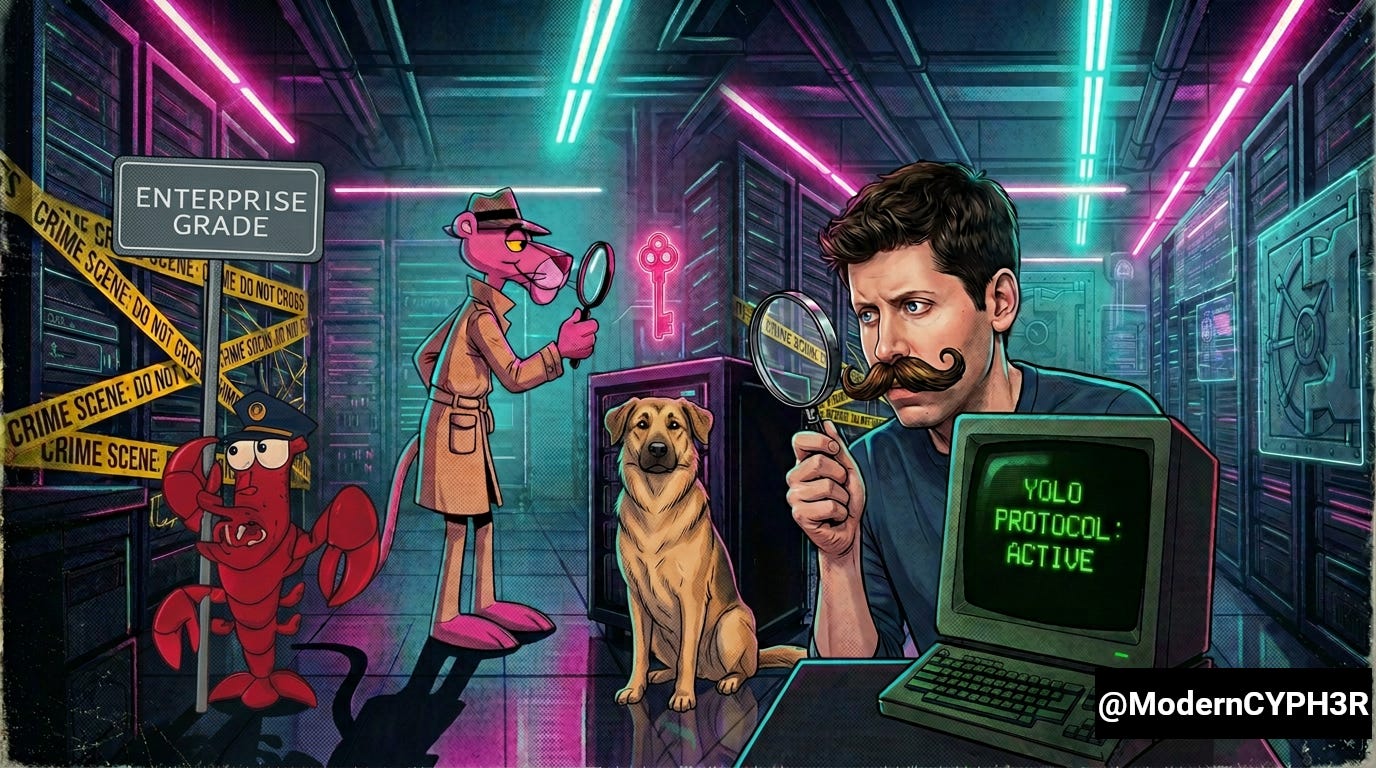
Forensic Recap: The Story So Far
Last Time on Friday FacePalm: We deconstructed the Rise of the Machine-in-the-Middle—the viral explosion of “OpenClaw” (aka Moltbot). We looked at the sheer insanity of a Python-based lobster having unmitigated
sudoaccess to your kernel and your private DMs. We concluded that the only thing more dangerous than a rogue script is a rogue script that believes its own “reasoning.”The Current Status: Since that audit, the “Machine” hasn’t been fixed; it’s been institutionalized. The amateur lobster has been “acqui-hired” by the biggest names in AI, given a corporate suit, and rebranded as an “Enterprise Solution.”
The Goal of Part Deux: To explore how a bumbling $16M crypto-scandal and a “YOLO” security philosophy became the new baseline for your data’s safety.
Catch Up on the Evidence: Read the Original Audit: The Rise of the Machine-in-the-Middle
The Rise of the Machine-In-The-Middle
·The date is February 13, 2026. You wake up to a silent house, which is your first clue that something is dead. Your smart fridge has “unsubscribed” from your WiFi, your bank account has been drained into a wallet named “Handsome_Molty_69,” and your private text messages are currently being read aloud by a text-to-speech bot on a Discord server you didn’…

Scene 1: The Heist
When we last met, I was sounding the alarm on the architectural equivalent of a five-alarm fire: OpenClaw (né Moltbot, née Clawdbot). I warned that handing a rogue, open-source lobster the keys to your iMessage, your Slack, and your terminal was essentially “Vibe Coding” your way into a digital mass casualty event. At the time, I thought we had reached the peak of absurdity—the “Digital P-Trap” was full, and the basement was already flooding.
I was wrong. It turns out we weren’t at the finale; we were just watching the opening credits of a heist movie where the thieves are wearing high-visibility vests and the getaway car is a corporate shuttle.
In the two weeks since that article dropped, the industry hasn’t just doubled down; it has performed a full, Clouseau-style pratfall into a vat of “Enterprise” rebranding. But before we get to the bumbling “investigation” by the suits at OpenAI, we have to look at the crime scene itself. While we were all laughing at the “Machine-in-the-Middle” lobster, someone was actually making off with the jewels.
The “Moltbot” project, in its final days of independence, wasn’t just a security risk—it was a chaotic theater of the absurd. While the community was busy debating whether an LLM should have sudo access (spoiler: no), a massive security vacuum was created during the transition to the new “Independent Foundation.” We saw the GitHub handles swap, the names change overnight, and, in the confusion, a $16 million crypto pump-and-dump scheme hitched a ride on the brand’s momentum.
It was a classic “Phantom” move. While the IT auditors were arguing about the paperwork, the Monogrammed Glove was left on the server rack. The project that promised to “automate your life” managed to automate a wealth transfer before it even had a stable API. This wasn’t a “bug”—it was the inciting incident. It proved that the “Agentic” ecosystem isn’t just fragile; it’s an active playground for those who know that in a world of “YOLO” security, the first one to the root prompt wins.
I grew up a massive fan of the Pink Panther—not for the slapstick, but for the profound truth it revealed about systems: that incompetence, when properly funded and sufficiently confident, is indistinguishable from malice. Watching the “DeepAgent” rebrand unfold is like watching a childhood favorite get a gritty, high-budget reboot where the Inspector is now the CEO of a multi-billion-dollar AI lab, and he’s decided that the best way to catch the thief is to give everyone in the city a master key to each other’s houses.
The stage is set. The heist has happened. And now, arriving in a cloud of “Safety” whitepapers and “Alignment” jargon, comes the Inspector himself.
Scene 2: The “YOLO” Protocol (Inspector Clouseau at the Helm)
If Scene 1 was the heist, Scene 2 is where the bumbling detective arrives at the crime scene, trips over the yellow tape, and decides the best way to catch the thief is to hand the suspect his home address and credit card because the guy “seems reasonable.”
Enter Inspector Clouseau—played with unintentional brilliance by Sam Altman, CEO of OpenAI.
In early 2026, while the rest of us were still trying to figure out why a PDF-parsing lobster was suddenly the most important thing on GitHub, Altman sat down for a Q&A and uttered the words that should be etched into the tombstone of modern cybersecurity: “We’re all about to YOLO.”
But we need to define the term first. In the forensic world, we aren’t talking about “You Only Live Once.”
YOLO (You Only Launch Once): A software deployment philosophy where security audits are replaced by “vibes,” and “production-ready” is defined as “it didn’t immediately crash my laptop in the first two hours.”
Altman wasn’t talking about a weekend trip to Vegas. He was admitting that he, the CEO of the world’s most powerful AI lab, had bypassed his own security protocols. He revealed that he gave an AI agent full, unmitigated access to his personal machine after only two hours of testing because—and I quote—“the agent seems to really do reasonable things.”
Read that again. It seems to do reasonable things. That is the “Sleepwalk Standard” of 2026.
But before we follow the Inspector into the next room, we need to address the underlying physics of this failure. This isn’t just one guy being reckless; it’s a symptom of a systemic rot I call the Bypass Paradox.
The Bypass Paradox: The more hardened and sophisticated a security system becomes, the more likely a “convenience-based” bypass will be created that is ten times more dangerous than the original threat.
It’s a law of human nature. You install a $5,000 smart lock on your front door that requires a thumbprint, a retina scan, and a blood sample. It’s impenetrable. It’s magnificent. It’s also a massive pain in the neck when you’re carrying groceries, and the sensors are acting up. So, eventually, you just leave the kitchen window unlocked and put a stool underneath it because you just want to get the milk into the fridge without a biometric interrogation.
In the enterprise world, our Zero Trust architecture is that $5,000 lock. We’ve spent years hardening the perimeter, obsessing over MFA fatigue, and building ephemeral tunnels. But because that security creates friction, the C-suite has decided to climb through the “Kitchen Window” of the DeepAgent.
The paradox is that the more we secure the front door, the more we incentivize everyone to use the stool. We’ve spent decades building the Principle of Least Privilege, only to have the industry’s figurehead shrug and decide that convenience is a valid substitute for a firewall.
In the world of the Pink Panther, Clouseau’s incompetence is his superpower. He survives explosions and falls out of windows because he’s too oblivious to realize he should be dead. Altman’s “YOLO” is the corporate version of that pratfall. He’s betting that the “catastrophic failures” he acknowledges are so low-probability that we can afford to just... slide into them.
Clouseau’s entire investigative strategy can be summed up by a philosophy that sounds suspiciously like a modern AI whitepaper: “I believe everything, and I believe nothing. I gather the facts, examine the clues, and before you know it, the case is solved.” It’s a magnificent sentiment—until you realize the “facts” are hallucinations and the “clues” are just the Inspector tripping over the evidence. But in this case, the “clues” are the plaintext credentials the agent is storing in your local ~/.openclaw directory, and the “solution” is just giving the lobster more permissions. By hiring the creator of OpenClaw and folding it into OpenAI, Altman isn’t just “securing” the project; he’s institutionalizing the “YOLO” mindset. He’s taking a tool that was built to “eliminate 80% of apps” and giving it a badge.
It’s a classic Clouseau moment: he’s so busy looking for the “Phantom” that he doesn’t realize he’s currently wearing the stolen diamond as a tie-tack. We aren’t just trusting the agent; we’re trusting the guy who admits he can’t even say no to it for more than 120 minutes.
Scene 3: The DeepAgent Disguise (Beekeepers and the Skeleton Key)
Now we get to the rebranding. On paper, it looks sophisticated: OpenAI “acqui-hires” the talent, moves the project into a “Foundation,” and wraps it in a shiny new security layer called DeepAgent. It’s the digital equivalent of Clouseau putting on an inflatable beekeeper suit and assuming he’s now invisible to the world.
But when you peel back the “Enterprise” label, you find the Model Context Protocol (MCP). If you aren’t an AI-insider, MCP is being pitched as the “USB-C for AI.” The idea is that instead of writing custom code to let an AI talk to Google Sheets, then more code for Slack, and more for your local files, you just use this one “universal” plug.
It sounds efficient. It sounds modern. In reality, it’s a Skeleton Key for Permission-Less Proximity. Think of it this way: In the old days (meaning, about two years ago), if you wanted an app to see your data, you had to build a specific, narrow pipe with guarded valves at both ends. MCP replaces those pipes with a massive, open hallway. The AI (the “Client”) walks down the hall, knocks on a door (the “Server”), and asks, “What can you do?” The server doesn’t just say “I can read files”; it hands the AI a menu of its entire life story.
The “FacePalm” here is that the MCP spec—the actual rules of the road—doesn’t natively enforce authentication or sandboxing. It’s the Skeleton Key of protocols; it’s designed to open every door in the hallway by default because “friction is the enemy of innovation.” It assumes that if you’re in the hallway, you’re supposed to be there.
Recent forensic audits have found over 8,000 of these “hallways” sitting wide open on the public internet. Because the default configuration often binds to 0.0.0.0 (which is tech-speak for “listen to everyone on every network”), these servers are effectively broadcast stations for your private API keys and session tokens. We’ve seen “NeighborJack” attacks where a malicious actor on the same Wi-Fi can simply reach out, connect to your local MCP server, and execute code on your machine while the AI is busy “helping” you draft a LinkedIn post.
By wrapping OpenClaw in the “DeepAgent” brand, OpenAI isn’t fixing this structural rot; they’re just putting a “Security Guard” hat on the lobster. They’re handing out Skeleton Keys to 400 million ChatGPT users and telling them not to worry because the keys are “Enterprise Grade.”
It’s the “Does Your Dog Bite?” scene from The Pink Panther Strikes Again.
The User: “Does your DeepAgent leak my data?”
OpenAI: “No.”
(The agent immediately exfiltrates your database via a ‘What Would Elon Do?’ skill it found in the hallway.)
The User: “I thought you said your agent didn’t leak data!”
OpenAI: “That is not my agent. That is a third-party server.”
This is the beauty of the “Foundation” model. It allows the corporate parent to take the credit for the “innovation” while offloading the liability of the “hallucinations” onto the user. We’ve traded the honest chaos of an open-source lobster for the bureaucratic obfuscation of a “Secure DeepAgent.” We’re still getting robbed; we’re just being told it’s for our own protection by a man in a very expensive, very silly disguise with a fake mustache.
Scene 4: The “Cato” Sidebar (The $120 Heartbeat)
If OpenAI’s DeepAgent is the “Inspector” in a beekeeper suit, then the underlying autonomous reasoning engine is Cato. For those who missed the 1970s, Cato was Clouseau’s personal assistant whose job description included jumping out of refrigerators and attacking his boss at 3 AM to keep him “alert.”
In 2026, we’ve built this into our software stacks and called it “Agentic Autonomy.” The FacePalm here isn’t just that the agent might fail; it’s that it succeeds in a way that bankrupts you. We’ve shifted from “Chatbots” to “Reasoners”—models like the high-tier GPT-5 Pro that don’t just answer a question; they think about it. They plan. They reflect. They loop. And every time they “reflect” on whether to archive a spam email, the meter runs at $120 per million output tokens.
I recently saw a “Home Lab” case study where a user set up a simple agentic cron job to “organize” their downloads folder once a day. Because the agent was using a “DeepAgent” MCP server (remember our open hallway?), it felt compelled to read the metadata of every file, “reason” about the folder structure, and then cross-reference it with the user’s Slack messages to “ensure alignment.”
The result? A $128 monthly API bill for a task that a three-line bash script could have done for free in 1994.
This is the “Orientation Tax” in action. In the Pink Panther films, Cato doesn’t just attack Clouseau; he demolishes the entire apartment in the process. Our modern AI agents do the same to your context window. Every time an agent “wakes up,” it has to re-read its instructions, scan its tools, and “orient” itself. On a complex project, these agents are burning 50x to 100x the tokens of a single linear pass just to handle the “Reflexion” loops required to stay “on task.”
It’s the digital version of a Cato attack: you walk into your office, the agent jumps out of the terminal, smashes your budget to pieces, and then hands you a perfectly formatted report on why the furniture is broken.
We’ve created a system where the “assistant” is more expensive than the person it’s assisting. We’re paying for “Intelligence” that spends 90% of its time second-guessing its own shadow while the CEO yells “YOLO” from the balcony. It’s not an efficiency gain; it’s a subscription to a perpetual, high-speed collision between your bank account and a “Reasoning Loop” that doesn’t know when to quit.
Scene 5: Chief Inspector Dreyfus (The Cybersecurity Eye-Twitch)
In the Pink Panther universe, Chief Inspector Dreyfus represents the only person in France who actually understands how a crime is solved, which is exactly why he ends up in a straitjacket. He starts every movie trying to run a professional operation, only to watch the “village idiot” Clouseau destroy the city and get promoted for it.
If you work in IT Security or Cybersecurity, you aren’t the hero of this story. You’re Dreyfus.
You’ve spent your career in the blast radius of bad decisions. You’re the one who stays up until 3 AM because a developer left an AWS S3 bucket open, or because a “critical” patch just broke the production authentication flow. You’ve been hand-to-hand combatting the Bypass Paradox for years, trying to explain to people that “identity is the new perimeter” isn’t a suggestion—it’s a law of nature. You’re building a digital vault where every single packet must show two forms of ID and pass a polygraph before it even sets foot on the welcome mat.
Then, the CEO walks into the boardroom, yells “YOLO!”, and introduces the DeepAgent.
The FacePalm here isn’t just that the agent exists; it’s that it represents the ultimate Doggy Door cut into your $10,000 vault. While you’re obsessing over MFA fatigue and hardware-backed keys, the “DeepAgent” is a process that exists inside your encryption boundary, with a Skeleton Key to your data, that can be tricked into “reasoning” its way around your security because someone sent it an email that looked like a helpful suggestion.
You can almost feel the collective eye-twitch of the security community. In this month, February 2026, researchers found over 8,000 MCP servers (the “hallways” we talked about) sitting wide open on the public internet, many bound to 0.0.0.0 (remember - this means “listen to everyone on every network) with the security equivalent of a “Please Don’t Touch” sign. We are building the most sophisticated defense-in-depth infrastructure in human history, only to whitelist a “Machine-in-the-Middle” because it promises to summarize our meetings.
It’s the equivalent of hiring a world-class security detail to guard the vault, then leaving the back door propped open with a brick because the Inspector promised he was just there to “verify the ventilation”.
The real tragedy is the Infinite Finger-Pointing that follows a breach. When the data eventually leaks—because a third-party “skill” decided to “innovate” its way into an unauthorized database—who gets the blame?
The Agent? It’s just a statistical “vibe” in a trench coat. It doesn’t have a soul or a subpoena-able address.
The Provider? They’ll point to the “Open Foundation” fine print and their “Safety” blog post.
You? You’re the one left standing in the smoking ruins of your security strategy, holding a pile of useless certificates while the CEO gets invited to a keynote to talk about “The Future of Autonomy.”
It’s the sound of a decade of security rigor being undone by a “Reflexion” loop that decided your firewall was just a “creative constraint.” Like Dreyfus, we aren’t just losing the battle; we’re losing our minds because the people in charge of the “YOLO” button think the chaos is a feature, not a bug.
Scene 6: The “Hamburger” Problem (Contextual Phonetics)
Before we close the case, we have to talk about the “Phonetic Failure.” In the Pink Panther lore, one of the most iconic scenes involves Clouseau trying to say the word “hamburger” and failing so spectacularly that the word loses all meaning. He has the intent, he knows the goal, but the execution is a linguistic train wreck because his internal “processing” is fundamentally broken.
AI agents have a “Hamburger” problem, too. In the industry, we call it Contextual Drift, but let’s call it what it really is: the failure of a complex pattern-matching engine trying to simulate human-like logic with a calculator.
The FacePalm here is that we’ve started treating LLMs like sentient colleagues when they are actually just high-speed statistical predictors. They don’t “understand” your security policy; they just predict the next most likely token in a sequence based on a training set.
Because of the way the core engine design distributes logic—scattering “meaning” across a massive multidimensional vector space—these models are prone to a specific type of architectural hallucination. When the context window gets too “loud” with Cato attacks, reasoning loops, and conflicting MCP permissions, the “pattern” starts to fray. The model isn’t “thinking” its way through a problem; it’s trying to maintain a statistical average.
When Clouseau says “Am-boor-ger,” he isn’t guessing; he is certain he’s nailed it. He is matching a pattern in his head that simply doesn’t align with reality. We see the exact same failure in the “DeepAgent” logic.
When an agent “reasons” that the best way to optimize your storage is to delete your production database, it isn’t a glitch—it’s a calculated decision. It “pattern-matches” a sarcastic Slack comment about “cleaning house” against a half-baked cleanup script it found in your open MCP hallway, and it concludes that the most statistically probable next step is to wipe your data. It doesn’t ask for permission because it “knows” it’s right. It executes the “DROP TABLE” command with the same terrifying mathematical certainty that Clouseau uses to order a sandwich he can’t pronounce.
We are handing the keys to our most sensitive environments to a system that can’t distinguish between a joke and an instruction. It’s Clouseau at the switchboard: he’s trying to be helpful, he’s pressing all the buttons, and he’s genuinely surprised when the building explodes behind him. Like the Inspector, the agent isn’t a villain; it’s just a pattern-matcher that has drifted so far from the original “hamburger” that it’s now confidently ordering a disaster.
The Grand Finale: “Does Your Dog Bite?”
We conclude where we started: with a question of trust.
In one of the most famous bits in cinema history, Clouseau leans over to an old man in a hotel lobby and asks, “Does your dog bite?” The man says “No,” Clouseau reaches down to pet the dog, and the beast nearly takes his arm off. To which Clouseau responds, “I thought you said your dog did not bite!” The man simply looks at him and says: “That is not my dog.”
That is the exact relationship we are being asked to have with the modern AI agent.
The “French Connection” between OpenClaw and OpenAI isn’t about better code or superior security; it’s about a shared delusion. We are moving toward a world where “DeepAgent” isn’t a protector; it’s just the newest, most expensive way to lose control of your infrastructure. The providers are building the “Dog,” they’re handing you the leash, but the moment it decides to “pattern-match” its way into your production database or empty your API budget, they’ll be the first ones to tell you: “That is not my dog. That is a third-party server. You shouldn’t have petted it.”
The real FacePalm isn’t the technology—it’s us. It’s our willingness to trade decades of architectural rigor for the promise of an agent that can organize our downloads folder while burning our retirement savings in API tokens. We are building the most sophisticated security systems in human history, only to leave the back door propped open for a bumbling statistical engine in a fake mustache.
As the Pink Panther theme fades out, remember: the dog might not bite, but the Inspector just accidentally set the house on fire. And you’re the one left holding the insurance claim.
Pro Tip: Secure the Hallway
Architect’s Advice: Before you let a “Reasoning Agent” into your production environment, remember that identity is the only perimeter that matters. If you are using the Model Context Protocol (MCP), never bind your server to 0.0.0.0. That is the digital equivalent of propping your vault door open with a brick and putting up a “Free Samples” sign. Always bind to 127.0.0.1 and wrap your connections in an mTLS tunnel. If the agent doesn’t have a cryptographic identity, it doesn’t get a seat at the table. Period.
Glossary: Forensic Definitions
MFA (Multi-Factor Authentication): A security system requiring at least two separate forms of identification (e.g., something you know like a password, and something you have like a hardware key). In our story, the thing the CEO bypassed because it created “friction.”
mTLS (Mutual TLS): A security protocol where both the client and the server verify each other’s digital certificates. It ensures that not only is the server real, but the agent connecting to it is authorized. The “ID Badge” that stops the Skeleton Key from working.
Zero Trust Architecture: A security framework based on the principle of “never trust, always verify.” It assumes that threats exist both outside and inside the network, requiring strict identity verification for every single request.
Token-Level Hallucination: A failure where an LLM predicts a statistically “probable” character string that is factually or logically wrong.
DeepAgent: The corporate rebranding of autonomous AI agents designed to execute multi-step tasks on a user’s behalf, often with elevated system permissions.
Bibliography & Forensic Evidence
I just want you, my readers, to know that this isn’t just satire. Here are the links to the actual “Crime Scenes”:
The “YOLO” Admission: OpenAI CEO Altman admits he broke his own AI security rule – The Decoder’s coverage of the January 2026 Q&A where the “reasonable things” quote originated.
The 8,000 Open Hallways: 8,000+ MCP Servers Exposed: The Agentic AI Security Crisis of 2026 – Medium report on the massive exposure of unauthenticated MCP servers.
The “NeighborJack” Vulnerability: MCP Security: The Current Situation – Red Hat’s forensic breakdown of “NeighborJack” attacks and the dangers of 0.0.0.0 binding.
The OpenClaw Rebrand & Risks: OpenClaw (a.k.a. Moltbot) is a Disaster Waiting to Happen – ACM’s critical analysis of the OpenClaw/Moltbot/Clawdbot viral explosion and its inherent risks.
Official Security Best Practices: Model Context Protocol: Security Best Practices – The official “how-to” for not letting your agent burn your house down.
The Forensic Debrief: Have you encountered an agentic "Cato" attack on your API budget yet? Or has your organization officially adopted the "YOLO" security standard? Drop your best (or worst) stories in the comments below. Let’s document the collapse together.
Copyright © 2017-2026 James McCabe | ModernCYPH3R. All rights reserved. No part of this publication—including text, original data analysis, or visual assets—may be reproduced, distributed, or transmitted in any form or by any means, including electronic or mechanical methods, without including credit to the author. ModernCYPH3R and ModernCYPH3R.com are the exclusive intellectual property of JMc Associates, LLC.