
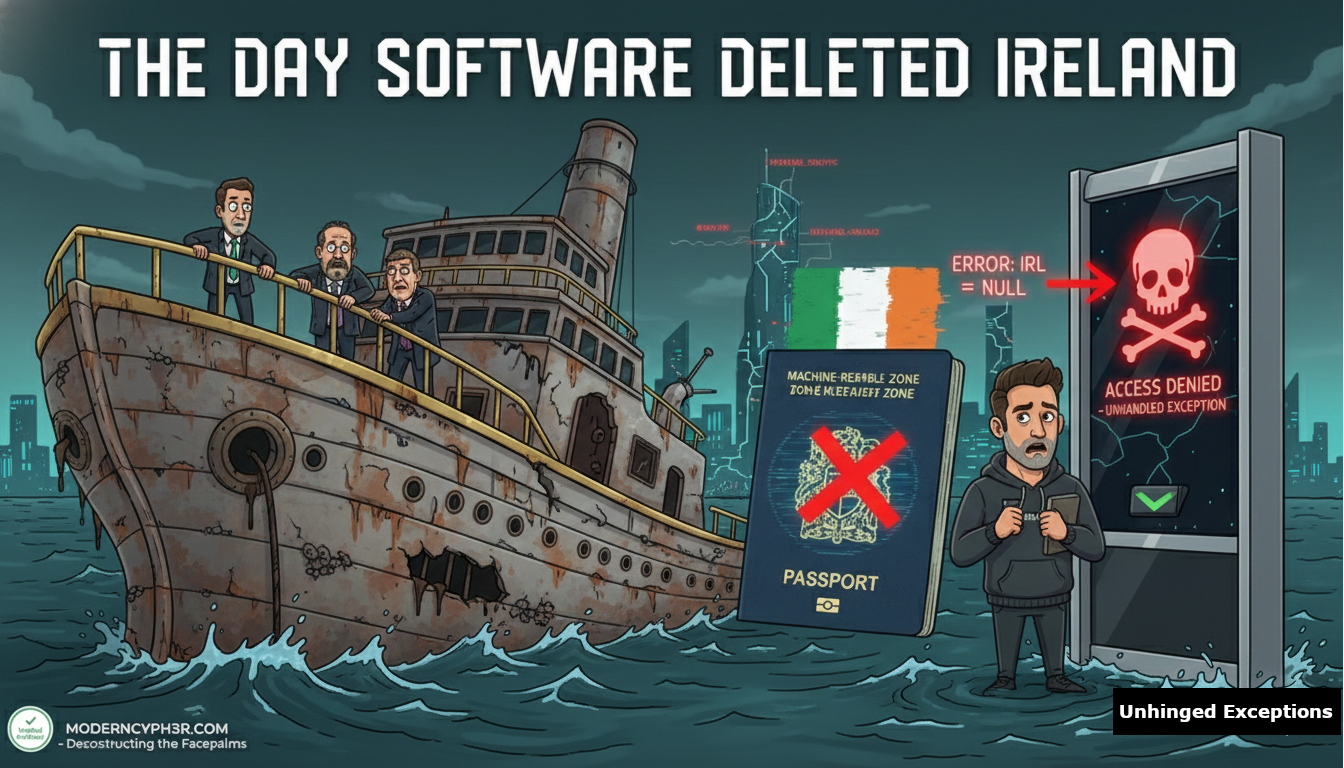
The Irish Department of Foreign Affairs recently hit an “unhandled exception” of national proportions. After investing €39 million into their “Passport 2025” modernization project—a system designed to be the global gold standard of identity—they hit a snag. A software patch, deployed during the peak holiday rush, caused a printing defect that omitted the “IRL” country code from the Machine-Readable Zone (MRZ) of nearly 13,000 passports.
To the bureaucrats, this is a “technical glitch.” To a Solutions Architect, this is a systemic warning light. We have reached a point where your physical existence, your birthright, and the high-resolution ink on your documentation are secondary to a three-letter string of metadata. If the metadata is missing, the human is “404 Not Found.”
The Expensive Theater of Modern Borders
We love to “modernize” legacy systems by slapping a high-tech interface on top of a rotting foundation. This is essentially polishing the chrome on a shipwreck. The “shipwreck” is our global identity infrastructure—a chaotic, centuries-old mess of paper trails, birth certificates, and physical borders. Instead of re-architecting how we verify humanity, we just keep adding “chrome”: biometric chips, 3D holograms, and automated eGates.
But here’s the problem: Chrome doesn’t keep a ship afloat. When the Irish software omitted those three letters, it didn’t matter how shiny the passport was or how advanced the biometric chip claimed to be. The “automated” gate looked for a specific database entry, found a “Null” value, and effectively exiled 13,000 people from the global travel network. We’ve spent millions making the gate look futuristic, but the logic powering it is as brittle as a glass hammer.
The Death of the Analog Fallback
The real “Logic Fail” here is the systematic removal of the Human Heuristic.
In the “Legacy Era,” if a passport had a printing smudge, a human customs officer would look at the document, look at your face, verify your accent, and use a “fuzzy logic” called common sense to let you through. They understood that the system was a tool, not the master.
Today, we have “optimized” the human out of the loop. We have replaced the grizzled officer with a machine running a binary “IF/THEN” script.
IF (CountryCode == “IRL”) → PASS
IF (CountryCode == NULL) → DENY
There is no “Exception Handling” for a software glitch in an eGate. By automating the process, we haven’t made the system more secure; we’ve just made it more fragile. We’ve traded “Human Error” for “Systemic Catastrophe.”
Database Desync: When the Map Replaces the Territory
In philosophy, there’s a concept that “The Map is not the Territory.” In Systems Architecture, we are currently suffering from a Global Database Desync where the map (the data) has become more important than the territory (the actual person).
13,000 Irish citizens didn’t lose their citizenship. They are still Irish. Their “Territory” is unchanged. But because their “Map” (the MRZ code) was corrupted by a bad patch, the global system treats them as stateless. This is the ultimate Unhinged Exception. We have built a world where the data record is the “Source of Truth,” and the physical human being is just a “Legacy Peripheral” trying to connect to it. When the data fails, the human is de-authenticated.
The Architecture of Trust: Building a Digital Gilded Cage
To understand why this is more than just a “government oopsie,” we have to look at the Architecture of Trust. Historically, trust was decentralized. You knew your neighbor, your local banker knew your face, and your identity was a composite of physical relationships and paper trails. It was slow, but it was “High-Availability.” If the courthouse burned down, the town still knew who you were.
In our rush to “Modernize,” we’ve replaced this resilient, mesh-network of trust with a Centralized API. Your identity is now a “Token” issued by a central server. We’ve been told that a Digital ID or a Biometric Passport makes us safer and “more verified.” In reality, it makes us Single-Point-of-Failure Dependencies.
When the Irish system failed to print “IRL,” it revealed the fundamental flaw in the “Digital Identity” dream: The system cannot verify what it has not been programmed to see. If the central authority (the software patch) says you are a “Null Value,” there is no higher court of appeal in an automated world. You are effectively locked out of the “Global OS.”
The Cascading Failure: From Passports to Everything
The Irish passport glitch is just the “Beta Test” for a much larger logic fail: the integration of all human activity into a single, brittle stack. Imagine this logic applied to Central Bank Digital Currencies (CBDCs) or Smart Cities.
The Vision: “Instant payments! Zero friction! Predictive traffic management!”
The Reality: A software update to the “Social Trust Module” accidentally flags your ID as “Delinquent” because you bought a steak instead of a salad.
Suddenly, your “Identity Token” isn’t just failing at the airport eGate; it’s failing at the grocery store, the gas pump, and your own front door. Because we’ve made the system “frictionless,” we’ve removed the emergency brakes. In a frictionless world, you can’t stop the slide once the logic fails. 13,000 Irishmen found out they couldn’t leave their country because of three missing letters. Tomorrow, you might find out you can’t buy coffee because of a “Sync Error” in your digital wallet.
The Solutions Architect’s Diagnosis
How do we stop this cycle?
First, we have to admit that Automation without an Analog Fallback is just a high-speed collision waiting to happen. A true “Solution” would involve “Degraded Mode” protocols. If an eGate sees a biometric chip that says “Ireland” but a machine-readable zone that says “Null,” it shouldn’t just lock the door. It should trigger a “Logic Divergence” alert that brings a human back into the loop.
Instead, we continue to prioritize “Frictionless Travel” over “Functional Logic.” We want the system to look so shiny that we don’t notice the water rising in the hold. We start by acknowledging that Technology is a Tool, not a Truth. A resilient system requires Multi-Factor Validation that includes a “Human Exception Layer.” If a system can’t handle a simple typo without exiling a significant portion of its users, then that system isn’t “Modern”—it’s “Broken.”
Check Your Own Hull
As we watch the Irish government scramble to “re-authenticate” its 13,000 “ghost citizens,” take a look at your own digital dependencies. How many “Single Points of Failure” are you carrying in your pocket?
We are living in an era of Systemic Fragility masked by High-Definition Displays. The interfaces are sleek, and the “user experience” is tailored to our every whim. But underneath it all, the logic is brittle, the foundations are rotting, and the shipwreck is taking on water.
It’s time to stop admiring the polish and start checking the hull. Because when the next “Logic Fail” hits, you don’t want to find out that your entire existence was dependent on a three-letter string that someone forgot to include in the latest patch.
Pro-Tip: Building a Human Firewall
In a world where software can “delete” your nationality, the only way to protect your personal “uptime” is to build redundancy into your own life. Here is how you audit your own hull:
The 3-2-1 Identity Rule: Never rely on a single digital token. Keep a physical copy of your credentials (3), stored in two different formats (digital/paper) (2), with one being completely offline in a safe location (1).
Audit Your API Hooks: Look at every service you use that relies on “Login with Google/Apple/Facebook.” If any of those “Central APIs” go down or flag you as an error, you lose access to everything. Diversify your authentication methods now before the next “Logic Fail” locks your digital front door.
The “Analog Fallback” Test: Ask yourself: if my phone died and my internet was cut for 48 hours, could I still prove who I am to a bank, a doctor, or a border agent? If the answer is “No,” you aren’t a citizen—you’re a cached credential.