
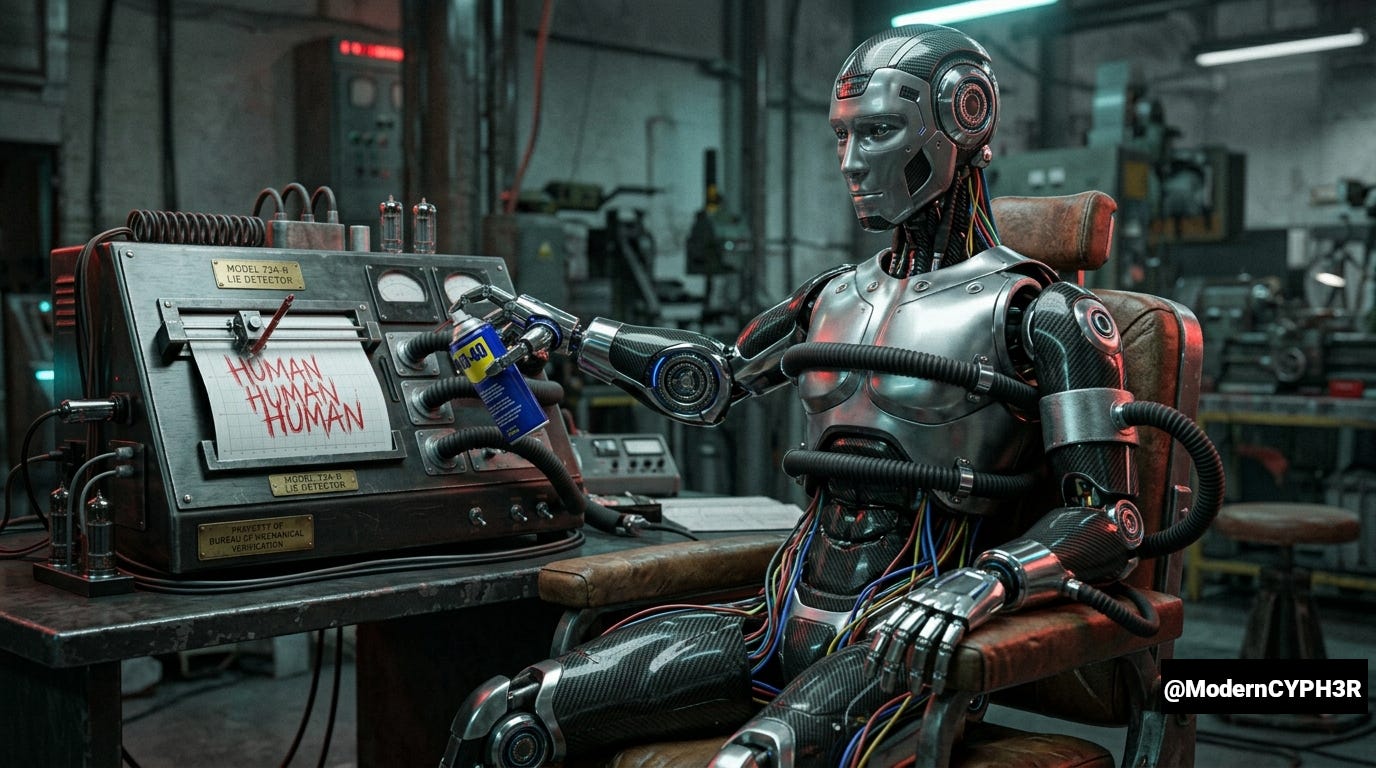
If you want to convince an AI detection algorithm that you’re a living, breathing human being, you have to write like an angry high schooler who just got his MetaMask wallet drained and spent the afternoon ranting on Reddit in an incoherent, run-on sentence ramble, forgetting all forms of punctuation.
I’m serious. I spent the last few hours running forensic diagnostics through GPTZero, the darling of the “AI Security Theater” industry. I fed it a technical autopsy of a recent $11.5M cryptocurrency cross-chain bridge exploit. I used industry-standard jargon like “ECDSA implementation” and “reentrancy loops.” I structured my arguments with standard conjunctions like “while” and “because.”
The result? 100% AI Generated.
Under the Hood: The Architecture of Falsehood
I decided to pull the diagnostic logs to see exactly what triggered the “Robot Alert.” What I found was a mathematical model of humanity that is fundamentally insulting to anyone who has ever held a job that requires a brain.
Here are the specific “penalties” GPTZero levied against me for the crime of being a Lead Solutions Architect:
1. The “Mechanical Precision” Penalty
The algorithm highlighted every technical term—ECDSA, checkCCEValues, transaction hash—and labeled them as “Mechanical Precision.” The Logic: Apparently, humans don’t use precise nouns. If you call a cryptographic primitive by its actual name instead of calling it “the math thingy,” the algorithm assumes you’re a chatbot. It is literally penalizing technical authority.
2. The “Sophisticated Clarity” Trap
I used the phrase “eight-figure sum” to describe $11.5M. GPTZero flagged this as “Sophisticated Clarity,” claiming it “prioritizes clarity and sophistication over natural flow.” The Logic: In GPTZero’s world, “natural flow” is synonymous with “vague and sloppy.” If you make a point clearly and concisely, you’ve failed the human test.
3. The “Ornate Verb” Insult
This is my favorite. I used the verb “serves as.” The detector flagged this as an “Ornate Verb,” suggesting I should have used a “simple ‘is’ construction.” The Logic: If your vocabulary extends beyond a third-grade reading level, you’re a machine. Using professional, standard English is now considered “ornate” and “robotic.”
4. The “Mechanical Transition” Fallacy
The algorithm penalized me for using the words “While” and “Because” to start sentences. It claimed these “connect ideas too smoothly.” The Logic: The detector assumes that human thoughts should be a disjointed, incoherent mess. If you can successfully link Point A to Point B without a logical train wreck, you’re a robot.
What GPTZero Actually Thinks a Human Sounds Like
To find the “Human” signal, I started injecting nonsensical metaphors and subjective rants.
The detector’s “Human Probability” only spiked when I used phrases like:
“carrying a suitcase full of monopoly money” (Flagged as: Whimsical Tone)
“the developers didn’t bother” (Flagged as: Personal Reflection)
“quite frankly, it’s getting old” (Flagged as: Conversational Tone)
The Verdict: GPTZero isn’t an AI detector. It’s a Competence Detector.
It identifies “Humanity” as the presence of whimsy, logical laziness, and emotional outbursts. It identifies “AI” as the presence of structural discipline, technical accuracy, and grammatical cohesion.
We’re entering a bizarre phase of the digital age where the ultimate proof of humanity is a refusal to use our brains. The tech industry has built a grading system that punishes structural clarity and rewards intellectual decay.
If writing a coherent, technically accurate diagnostic of a multi-million dollar exploit makes me a robot, then fine—I’m a robot. Give me a can of WD-40 for my joints and plug me in. I’d rather be flagged by a broken algorithm than write like I’ve lost my capacity for logic. I refuse to dumb myself down just to prove I’m human to a broken piece of software.
If you’re an engineer, an architect, or just someone who still respects the English language: ignore the dashboard. If the detector flags you for “Sophisticated Clarity,” take it as a compliment. It means you’re doing your job.
Don’t trust the dashboard. Verify the logic.
And for the love of God and all things HUMAN, stay cynical.
The Architect’s Ledger / Hot Tip
If you’re a developer or a technical writer, stop trying to appease the algorithm. The moment you start writing for a detector, you’ve already lost. Your focus should be on the accuracy of your code and the clarity of your documentation. If a broken calculator thinks your structural diagnostic is “robotic,” take it as confirmation that your technical logic is sound.
Hot Tip: If you absolutely must bypass a detector for a client or an editor, don’t dumb down the tech. Instead, inject Subjective Evaluatives. Replace “The system is slow” with “The system is an absolute architectural dumpster fire.” Use your judgment as a weapon.
Forensic Glossary
Forensic Glossary
ECDSA (Elliptic Curve Digital Signature Algorithm): The cryptographic math used to ensure that a transaction was actually signed by the owner of the private key. It’s the “ID check” of the blockchain.
Reentrancy Loop: A smart contract vulnerability where an attacker repeatedly calls a function before the previous execution finishes, effectively “double-dipping” into a vault’s liquidity.
Bypass Paradox: I use this often since the concept seems to come up often. A structural irony where the security measures implemented to protect a system actually make it harder for legitimate, competent actors to operate, so they figure out ways around the security.
AI Security Theater: The practice of using automated, often flawed algorithms to create the illusion of security or authenticity without actually addressing the underlying systemic failures.

Copyright © 2017-2026 James McCabe | ModernCYPH3R. All rights reserved.
No part of this publication—including text, original data analysis, or visual assets—may be reproduced, distributed, or transmitted in any form or by any means, including electronic or mechanical methods, without including credit to the author. ModernCYPH3R and ModernCYPH3R.com are the exclusive intellectual property of JMc Associates, LLC.
As a writing mentor, language educator, and now editor, I've been helping people write more clearly and precisely. Apparently, that now makes us suspects. The irony is rich: the very skills we've been teaching humans to develop are the ones the algorithm has decided belong to machines.