
It’s May Day. Usually, this is the part of the year where people talk about flowers and renewal, but in the enterprise sector, I’m mostly hearing the “Mayday” distress signal. I was sitting on the deck this morning, enjoying a sunshine-filled May 1st (May Day), but my headspace was stuck on the sheer, unadulterated vanity of our current cryptographic transition.
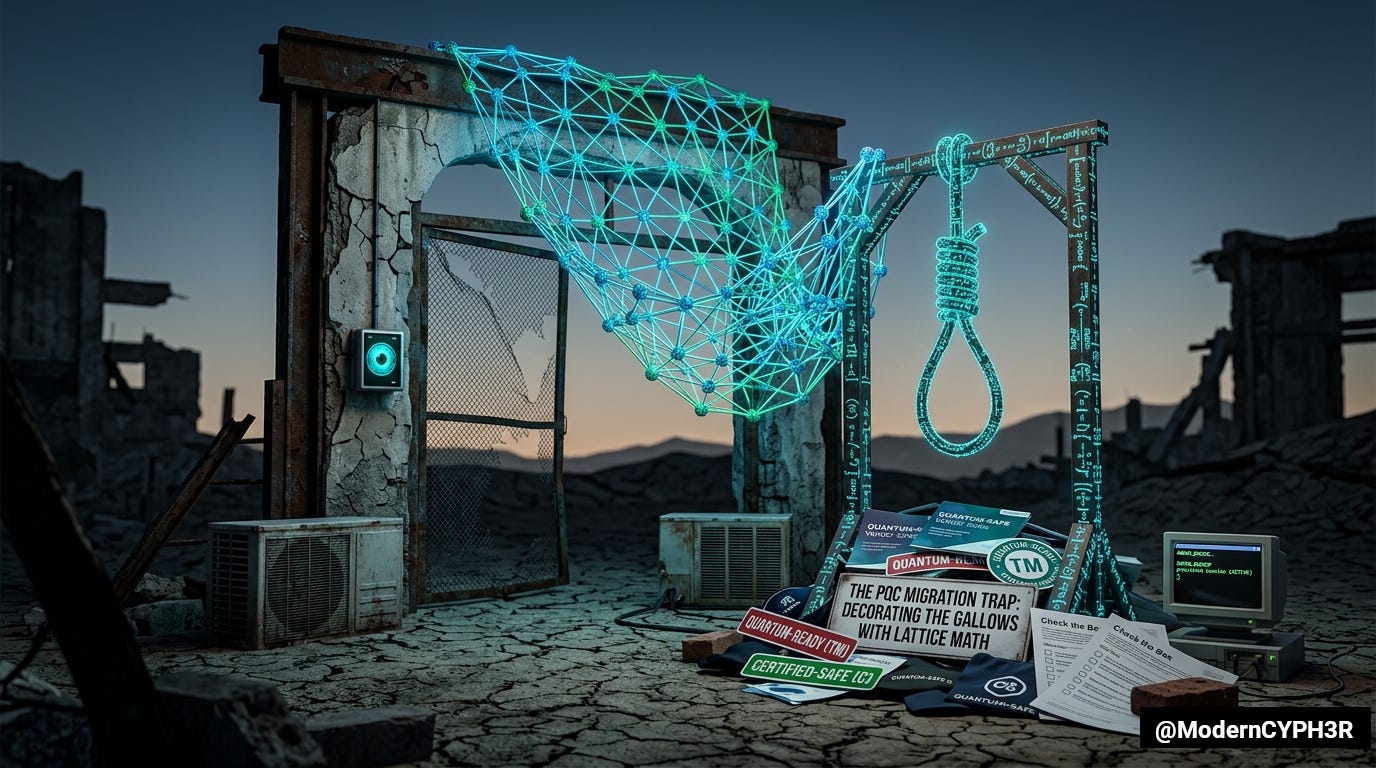
The corporate world is currently scrambling to hit these new Post-Quantum Cryptography (PQC) deadlines, and the result is predictable: global agencies and Fortune 500s are caught in The Migration Trap. I call it “Decorating the Gallows.”
“Quantum-Ready” stickers are being slapped onto legacy compute stacks like they’re organic produce at a boutique grocery store. But here’s the cold truth: dropping a 48-dimensional topological encryption layer into a fractured identity perimeter doesn’t make a system “secure”, it just makes the inevitable failures exponentially more expensive to debug. The collective decision-making process seems to be that if the underlying logic is too shameful to show, the best move is to bury it under a mountain of lattice-based math and hope the auditor doesn’t bring a shovel.
The Simple vs. Easy Paradox (High-Fidelity Edition)
The PQC gold rush is the ultimate stress test for the Simple vs. Easy paradox.
Easy is cutting a seven-figure check for a “Quantum-Safe” VPN subscription to satisfy an auditor who wouldn’t know a public key from a house key. It’s a clean transaction. It produces a glossy PDF for the C-suite. It allows the Board to sleep better while the actual house is on fire.
Simple is acknowledging that if internal data hygiene is a dumpster fire, the “quantum-ness” of the lock on the front door is irrelevant.
The industry is currently building and deploying the most complex encryption in human history atop the most fragile infrastructure it has ever owned. If a “Secure by Design” strategy starts with a vendor’s sales deck and ends with a “Check the Box” audit, it isn’t preparing for the future; it’s just applying a fresh coat of paint to a reactor core that’s already in thermal runaway.
Diagnostic: Handshake Obesity and the Physics of Failure
Let’s get into the forensic reality of why this “Quantum-Ready” transition is a disaster in waiting. Security teams are attempting to replace lean, 32-byte elliptic curve keys with massive, multi-kilobyte PQC structures.
This isn’t just a software swap; it’s a violation of the basic physics that modern networks were built on.
Traditional handshakes are surgical—a lean, three-step negotiation where the client and server agree on the “rules of engagement.” In a standard TLS exchange, this is the pre-game dance where both parties exchange a few hundred bytes to verify who they are and decide which cryptographic “language” they’ll speak. It’s fast, it’s efficient, and it fits into a single network packet like a well-tailored suit.
PQC handshakes, by contrast, are lumbering beasts. Because the new math requires massive keys and signatures, that elegant three-step dance has turned into a multi-frame logistics project. We’re moving from sending a 32-byte postcard to shipping a flat-packed bookshelf. When this “Quantum-Ready” payload, now bloated to 15 or 20 kilobytes, is shoved through a legacy load balancer that was hardcoded in 2014 to expect a specific, tidy packet size, the system doesn’t “fail over”, it panics. It sees the fragmented data and the “overweight” handshake as a potential buffer overflow attack, and its only instinct is to drop the connection and pull the fire alarm. It would seem we forgot that the internet’s plumbing was built for letters, not grand pianos.
The failure point isn’t the math; it’s the MTU (Maximum Transmission Unit). A PQC-wrapped TLS 1.3 handshake frequently spills over into multiple packets. When those fragmented packets hit an ancient firewall buffer that treats anything larger than a standard frame as a DDoS attempt, the connection is silently dropped.
It’s an attempt to perform a heart transplant on a patient whose arteries are already clogged with legacy sludge, using a heart that is four times the size of the original. The math is “unhackable,” but the plumbing is going to burst the moment the pump is turned on.
Forensic Audit: The Hybrid Handshake
The current “solution” to the quantum transition is the Hybrid Key Encapsulation Mechanism (KEM). The vendor narrative is seductive: “We’ll just wrap the new, unproven lattice-math around your reliable, old-school math.”
In reality, this is a masterclass in doubling failure rates while congratulating oneself on “defense in depth.”
By running two distinct cryptographic stacks simultaneously, organizations haven’t halved their risk; they’ve doubled their exposure. They are now vulnerable to the legacy implementation bugs of the old stack and the fresh, “hope-this-works” logic of the PQC layer.
It takes a unique kind of optimism to assume that adding more moving parts to a high-speed logical gate will somehow make it more predictable. In practice, it just creates a Timing Side-Channel Buffet for anyone patient enough to watch the friction.
The Identity Shame: The Biometric Screen Door
I was staring at the screen door on my deck, watching a fly try to find a hole in the mesh, and it hit me why this PQC obsession feels so fundamentally dishonest. It’s the sheer, unadulterated vanity of it all. The tech sector is acting like the existential threat is a yet-to-be-built quantum computer, while the actual threat is that it has spent 20 years building “Enterprise Identity” on a foundation of loose sand.
It’s the Biometric Iris Scanner on the Screen Door.
Corporations are going to spend the next five years and a few hundred million dollars of shareholder value to ensure that key exchanges are mathematically “unbreakable.” They’ll update the “Zero Trust” slide deck and go home early. But while they’re busy admiring the high-dimensional topology of a new encryption layer, the HVAC contractor is still logged into the Company’s domain controller using a persistent admin account that was created during a “temporary” emergency in 2019.
Architects will argue for three hours about lattice parameters, but rotating a service account password is still considered ‘too risky’ for the business. It’s a $50,000 security system on a house with no walls.
If I can walk through the front door because the key was left under the mat, or because the door was replaced with a screen door, it doesn’t matter if the lock is made of quantum-resistant titanium or a paperclip.
Closing: Simplicity as the Only Sanctuary
I’m finishing my coffee. A well-balanced blend that actually tastes like what it says on the label of the beans I ground this morning, without needing a “Quantum-Ready” marketing campaign. And I’m looking at this mess through the lens of a guy who has spent too many years cleaning up “innovative” disasters.
Architectural simplicity is the only sanctuary left, and it is the most expensive thing an organization can buy because it costs the ego of the architects involved. It requires the uncomfortable silence in the boardroom when someone suggests that maybe, just maybe, corporations should stop buying 'Quantum-Safe' locks for the auxiliary entrances they only built to bypass their own rules. In an enterprise environment, every unnecessary door is a liability. The most 'Quantum-Safe' thing you can do for a system isn't upgrading the lock, it's bricking up the opening entirely.
True security is boring. It’s the quiet competence of a clean identity flow. It’s the “No” that gets said to a vendor’s shiny new wrapper because the underlying architecture is already solid enough not to need it.
The corporate world is so busy decorating the gallows with these high-dimensional math stickers that it has forgotten the point of the exercise. If a security model can’t be explained to a peer without using fifteen buzzwords and a “Quantum” prefix, it isn’t a strategy. It’s a prayer.
I’ll be on the deck if anyone needs me. I’ll be the one with the freshly made French press (so simple), and the very, very simple network.
#PQC #CyberSecurity #ModernCYPH3R #FridayFacepalm #SimplicityIsSanctuary #LogicOverLattices #SecurityTheater #IdentityShame #HandshakeObesity
The Architect’s Ledger: The Physics of Failure
The math of Post-Quantum Cryptography is technically “elegant” in a chalkboard-theory kind of way, but physics doesn’t care about elegance. Physics cares about the size of the pipe.
To make sense of the bloat, consider the internet’s plumbing. Most data traveling across the world is chopped into packets of 1,500 bytes. This is the MTU (Maximum Transmission Unit). Think of it as the standard-sized mail slot on a front door. For twenty years, organizations have been sending “letters” (encryption keys) that were so small they slipped through the slot without even touching the sides.
Now, the corporate world is trying to ship “furniture” through that same mail slot.
I. The Entry-Level Bloat (128-bit Security)
This is the "standard" security level used for most web traffic and VPNs.
Why this is madness: The jump from a 32-byte "postcard" to a 1,184-byte "thick envelope" seems manageable until you add the rest of the digital handshake—certificates, timestamps, and overhead. The total payload quickly exceeds the 1,500-byte mail slot. The system is forced to "fragment" the data, tearing the envelope in half. If the recipient’s hardware isn't expecting two pieces, it assumes the mail is tampered with and throws it in the trash.
II. The "Top Secret" Bloat (256-bit Security)
This is the high-grade level used by government agencies and financial backbones.
Why this is madness: Look at ML-DSA (Dilithium). At 4,595 bytes, a single digital signature is now three times larger than the entire mail slot. To “sign” a message, the stack has to chop that signature into four separate packets. Then there’s SPHINCS+. At nearly 30,000 bytes, a single signature requires twenty separate packets just to say “Hello, it’s really me.”
In an aviation context, it’s like taking a plane designed for 100 passengers and filling every seat with a 500-pound lead weight. Technically, the weights "fit" in the seats, but the center of gravity is ruined, the takeoff speed is now impossible, and the landing gear is going to collapse the moment the plane touches the runway.
Enterprises are deploying “Quantum-Safe” Ferraris that are being delivered through mail slots. Every “Handshake” at this level is now a multi-frame logistics project that legacy hardware is almost guaranteed to drop. It’s not a migration; it’s a controlled flight into terrain.
The ModernCYPH3R Glossary: Deciphering the Vanity
If you’re going to survive a boardroom meeting about the “Quantum Apocalypse,” you need to know what these terms actually mean, not what the vendor’s sales deck says they mean.
PQC (Post-Quantum Cryptography): A set of mathematical algorithms designed to resist being broken by a quantum computer. In practice, it’s the industry’s current excuse for replacing sleek, efficient code with massive, bloated math.
CRQC (Cryptographically Relevant Quantum Computer): The hypothetical “monster under the bed.” It’s a quantum computer powerful enough to break standard RSA and Elliptic Curve encryption. We don’t have one yet, but we’re breaking our current networks just in case one shows up.
ML-KEM (Formerly Kyber): The NIST-standardized “Key Encapsulation Mechanism.” It’s the primary way the industry plans to exchange secrets in the future. It’s mathematically brilliant and physically “obese.”
ML-DSA (Formerly Dilithium): The primary digital signature algorithm. It’s what proves you are who you say you are. At higher security levels, the signature is so large it requires its own zip code.
MTU (Maximum Transmission Unit): The 1,500-byte speed limit of an Ethernet frame. It’s the “mail slot” of the internet. If your handshake is bigger than the MTU, the network has to chop it into pieces.
Fragmentation: The process of breaking a single data packet into multiple smaller ones. In a PQC world, fragmentation is the silent killer that triggers “DDoS protection” in legacy firewalls.
Hybrid KEM: The “Security Mullet” business in the front (reliable Elliptic Curve), party in the back (experimental Quantum math). It involves running two encryption schemes at once, effectively doubling the chance of a logical failure.
HNDL (Harvest Now, Decrypt Later): The strategy where nation-states steal your encrypted data today, betting that a quantum computer in 2030 will be able to open it. It’s why PQC is a “Mayday” signal for data with a ten-year shelf life.
Lattice-Based Cryptography: The specific branch of math used for PQC. It involves finding the shortest vector in a high-dimensional grid. It’s the “48-dimensional topological layer” I mentioned. Beautiful on a whiteboard, a nightmare in a packet.
Bibliography & Forensic Resources
For those who want to see the blueprints of the gallows before we finish decorating them:
NIST FIPS 203 (Module-Lattice-Based Key-Encapsulation Mechanism): The official “Bible” for ML-KEM. This is where the “newspaper-sized” keys were standardized.
NIST FIPS 204 (Module-Lattice-Based Digital Signature Standard): The technical specifications for ML-DSA. Essential reading if you want to understand why a digital signature now weighs as much as a small dog.
“An Efficient Key Recovery Attack on SIDH” (Castryck & Decru, 2022): The research paper that killed the “Small Key” PQC dream. It proves why we are stuck with “Big Math” lattices—because the smaller, elegant alternatives were decimated by a single-core laptop.
RFC 9390 (Hybrid Key Encapsulation Mechanisms for TLS 1.3): The blueprint for the “two pairs of pants” strategy. It details how the industry plans to layer PQC over legacy math.
Cloudflare Research: “Post-quantum TLS 1.3 in the Wild” (2024-2025): Real-world telemetry on how packet fragmentation and “handshake obesity” lead to increased connection failure rates in legacy environments.
“Quantum-Resistant” vs. “Quantum-Ready”: A Semantic Forensic Audit: My previous notes on how marketing departments hijacked cryptographic terminology to sell subscriptions for products that don’t actually exist yet.
