
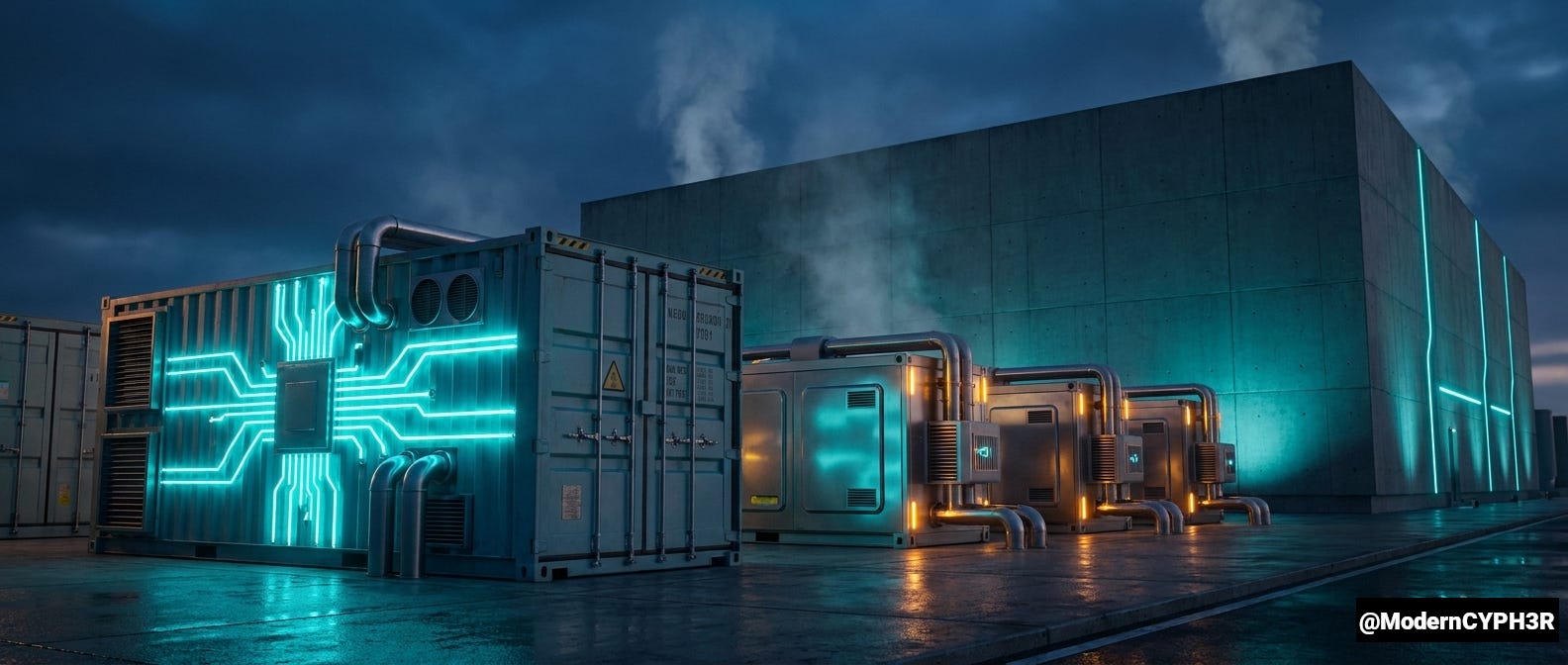
In Part 1 of this series, I exposed how hyperscale AI data centers act as literal concrete parasites, sucking down the power equivalent of 20,000 homes per facility and driving up local utility bills. In Part 2, I took a scalpel to the “Thermal Cop-Out,” showing how these same companies boil millions of gallons of drinking water just to keep their Capital Expenditures (CapEx) artificially low.
You can catch up here if you haven’t read Part 1 or 2:
The Concrete Parasite (Part1): The Dystopian Subsidy: Why You’re Paying for the Cloud
The Concrete Parasite (Part 2): The Thermal Cop-Out: Why You’re Drinking the Cloud’s Exhaust
Now, I’m diving into the final piece of this colossal engineering failure: The Grid.
The North American electrical grid is a marvel of mid-century engineering. It was designed for predictable, seasonal residential rhythms, not the insatiable, constant appetite of massive commercial compute. When I watch these multi-billion-dollar tech cartels plug a 500-megawatt AI campus, a colossal industrial load drawing a flat-line, 24/7 continuous stream of power without a single millisecond of reprieve, directly into a fragile municipal grid built for the simple daily rhythms of household appliances and residential air conditioners, I am looking at a special brand of engineering insanity that guarantees localized blackouts.
When the grid inevitably buckles, what is the tech industry’s backup plan?
Diesel. Millions of gallons of toxic, 1970s-era diesel fuel are burning under emergency air pollution waivers quietly rubber-stamped by desperate regulators whenever local power systems collapse.
The Diesel Dinosaur
If you drive past any of these high-density server farms in Loudoun County and peer behind the sterile, windowless concrete facades, you’ll see acres of massive, industrial-grade diesel generators that look like they belong on an offshore oil rig—monstrous relics of 1970s heavy engineering that represent the tech industry’s entire, intellectually bankrupt failover strategy when their fragile grid-drain inevitably causes localized systems to collapse.
It’s a dirty, inefficient, archaic failover mechanism for an industry that claims to be inventing the future.
When the local grid fails under the weight of AI training cycles, these facilities fire up their diesel fleets to keep the GPUs humming. Aside from the obvious environmental disaster of burning crude oil to power a server rack, these generators suffer from a mechanical failure known as “wet stacking”. Unburned fuel builds up in the exhaust system because the generators are oversized and constantly idling.
It’s pure mechanical laziness.
The “BYOP” Mandate (Bring Your Own Power)
I say it’s time to stop subsidizing the cloud. If Amazon, Microsoft, and Google want to build the compute engines of the future, they need to engineer their own sustainability.
I’m calling for a strict Bring Your Own Power (BYOP) mandate.
If a multi-billion-dollar tech monopoly wants to erect a million-square-foot facility to train their next-generation models, they must be legally barred from tying their primary megawatt-scale loads into the municipal energy grid—forcing them to deploy prefabricated Small Modular Reactors on-site to generate their own clean, zero-emission baseload power rather than simply socializing their massive utility bills onto local residential ratepayers. And yeah, it is a higher CapEx spend, but when your market cap sits in the trillions, you don’t get to ask a local family on a fixed income to subsidize your balance sheet.
What does BYOP look like in practice? It requires two major architectural shifts:
1. Primary Power: Small Modular Reactors (SMRs)
The only baseload power source dense enough and clean enough to run a gigawatt AI campus is nuclear. Specifically, Small Modular Reactors (SMRs). Unlike legacy nuclear plants that take twenty years and $30 billion to build, SMRs are prefabricated, self-contained micro-reactors where the entire power generation setup fits neatly inside a standard shipping container. This compact physical footprint means you don’t need miles of barren security fencing—the entire physical security perimeter sits on the same corporate campus, tucked directly next to the data center itself. They’re also physically incapable of a meltdown due to passive cooling physics.
But let's address the inevitable bad-faith counterargument before some armchair critic screams about "nuclear water cooling." Legacy nuclear plants require massive rivers or oceans to dump waste heat. Advanced Gen-IV microreactors don't. Many modern microreactors (like the DoD's Project Pele) use gas cooling (helium) or liquid-metal, requiring exactly zero operational water feedstock. For water-cooled SMR designs (like NuScale), the primary system is factory-sealed and closed-loop, meaning we can mandate dry-cooling (radiator-style) condenser arrays for heat rejection. Yes, dry cooling comes with a minor 2-5% efficiency penalty, but to a trillion-dollar tech monopoly, that’s a minor engineering trade-off to completely protect local municipal drinking water.
If a tech giant wants a million-square-foot facility, they buy a micro-reactor. They generate their own clean, zero-emission power on-site. Better yet, any excess capacity they generate gets fed right back into the local grid, turning the concrete parasite into a community asset.
2. Backup Power: Solid-Oxide Fuel Cells
The diesel generators have to go. The state Department of Environmental Quality (DEQ) needs to stop issuing air permits for these toxic dinosaurs.
The immediate alternative is solid-oxide fuel cells, like those built by Bloom Energy. These “Energy Servers” convert natural gas, biogas, or pure hydrogen into electricity without combustion. Each modular power unit occupies a physical footprint roughly equivalent to a standard parking space, making them incredibly easy to scale. No smog, no vibration, no wet stacking. Giants like Google, Pepsi, FedEx, and eBay already deploy these servers to bypass legacy utility constraints. They’re quiet, highly efficient, and can be deployed at scale on-site to replace every single diesel generator currently poisoning the county line.
Can solar play a role here? Absolutely. On-site solar arrays can generate the clean electricity required to run electrolyzers, producing green hydrogen to feed these fuel cells during peak grid stress. But let me clear up a lazy technical misconception before the armchair internet chemists try to call me out: split chemistry still requires a water feedstock. Even if you fractionate salt water to source your hydrogen, the electrochemical process of cracking those saline molecules still consumes raw water feedstock, meaning you’re simply trading a municipal grid drain for a hydrological drain unless you deploy advanced, closed-loop exhaust condensers to capture the pure water byproduct and feed it right back into the on-site electrolyzers to complete the loop. No free lunches exist in thermodynamics.
Stop Begging, Start Mandating
While the hyperscalers will inevitably whine about regulatory bottlenecks at the Nuclear Regulatory Commission or scream that solid-oxide fuel cells ruin their precious capital expenditure ratios, I don’t care about their spreadsheet-driven corporate excuses. They created this thermodynamic power arms race, and they are the ones who must pull out their checkbooks and fund the localized grid infrastructure to support it.
I’m not asking them politely. I’m demanding architectural accountability. They’ll try to hide behind legacy land-use loopholes, claiming their pre-approved “by-right” zoning permits shield them from any new municipal obligations, but I’ll address exactly how to shatter those legal shields in the final chapter.
In Part 4: The Policy Hammer, I’ll lay out the exact legislative playbook needed to force this transition, including the open letters I’m delivering to the Virginia Governor and the Loudoun Board of Supervisors.
The No-Fluff Infrastructure Glossary
BYOP (Bring Your Own Power)
The Jargon: Off-grid microgrid generation for mission-critical digital infrastructure.
The Reality: Generating electricity on-site instead of plugging directly into the public utility grid like a parasite. Think of it as parking a miniature nuclear reactor or industrial fuel cells in your lot because the local power company’s ancient transformers will literally melt if you try to spin up another cluster of AI chips.
“By-Right” Zoning
The Jargon: Non-discretionary development conforming fully to pre-existing land-use designations.
The Reality: A bureaucratic cheat code that lets developers bypass public hearings, environmental impact reviews, and county votes entirely. Because this decades-old, rubber-stamped land-use designation pre-approves specific industrial projects without requiring county oversight, local zoning boards found themselves legally bound to approve massive, energy-devouring AI installations—even when those sterile concrete fortresses threatened to exhaust the local residential power grid and drain municipal reservoirs dry.
Closed-Loop Dielectric Fluid Immersion Cooling
The Jargon: Two-phase liquid immersion thermal management for high-density compute clusters.
The Reality: Instead of relying on the primitive, brute-force method of blowing chilled air across rows of molten-hot silicon chips using cheap plastic fans, this elegant engineering system submerges entire naked server boards directly into a bath of synthetic, non-conductive fluid that absorbs heat instantly at the chip level, reutilizing the exact same liquid indefinitely without consuming a single drop of municipal drinking water.
GPU (Graphics Processing Unit)
The Jargon: Parallel-processing accelerator for deep learning workloads.
The Reality: A hyper-specialized microchip designed to perform millions of complex mathematical calculations at the exact same time. Originally built to make video games look pretty, these hungry silicon beasts now serve as the structural muscle behind modern AI training—and they generate an apocalyptic amount of heat while doing it.
Open-Loop Evaporative Cooling
The Jargon: Economical adiabatic cooling using municipal utility infrastructure.
The Reality: A primitive, lazy thermal hack. Instead of paying a premium for closed-loop fluid systems, hyperscale data centers take millions of gallons of pristine, potable municipal drinking water directly from public reservoirs, run it over hot server heat exchangers, boil it into steam, and blast it straight into the sky where it can never be recovered, leaving local taxpayers to pick up the tab for depleted municipal water supplies. It’s the engineering equivalent of cooling your car engine with a garden hose and letting the water run down the sewer drain.
SMR (Small Modular Reactor)
The Jargon: Gen-IV modular fission technology for localized industrial baseload.
The Reality: A compact, factory-assembled nuclear reactor that delivers steady, carbon-free baseload electricity. Think of it as an enterprise-grade, factory-fabricated nuclear submarine engine parked directly in a data center’s back lot, delivering a continuous, unyielding stream of clean, carbon-free gigawatts to hungry AI processors without begging the local public utility grid for a single drop of juice or forcing struggling residential ratepayers to subsidize the transmission lines of a trillion-dollar tech monopoly.
Solid Oxide Fuel Cells (Bloom Energy Servers)
The Jargon: Electrochemical natural gas/hydrogen conversion for decentralized baseload.
The Reality: High-efficiency, fuel-flexible power generation modules that bypass combustion entirely to produce direct-current electricity. They use highly efficient, non-combustion electrochemical reactions to convert fuel,including natural gas, landfill biogas, and zero-carbon green hydrogen, directly into electricity. These utility-grade power pods, each roughly the size of a standard parking space, act as localized micro-power plants parked right outside the facility wall. This lets giants like Google, Yahoo, and FedEx eliminate those filthy, noisy diesel generators that sit idling in parking lots. Those legacy systems are kept on standby purely to spew raw particulate matter into the local airshed. Regulators quietly rubber-stamp emergency pollution waivers for them whenever the public grid starts to collapse.
Salt-Water Fractionation (The Green Hydrogen Trap)
The Jargon: Saline electrolysis feedstock separation for carbon-free fuel generation.
The Reality: The process of using electricity (often from solar) to split water molecules (including desalinated seawater) to extract hydrogen gas. While tech giants advertise this as “green fuel,” they hide the fact that splitting molecules still consumes water molecules. You’re literally destroying water to create energy. Unless the facility runs advanced closed-loop exhaust condensers to capture the water vapor emitted when the hydrogen is recombined/burned and pumps it back into the electrolyzers, it’s just another resource drain masquerading as a sustainability PR stunt.
Bibliography
Virginia State Corporation Commission (SCC)
The Technical Core: Establishes the ~9% residential rate spike (7.5% starting Jan 2026, 1.5% in Jan 2027) and the historic creation of the “GS-5” rate class forcing data centers over 25MW to sign 14-year contracts and pay for 85% of contracted capacity in Docket No. PUR-2025-00058.
Verifiable Source: Virginia SCC Final Order (PDF)
Loudoun County Board of Supervisors
The Technical Core: The official repeal of administrative “by-right” data center development on March 18, 2025, forcing all new facilities to secure a Special Exception (SPEX) requiring public planning commission votes and legislative hearings.
Verifiable Source: Data Center Standards & Locations Index
Bloom Energy Corporation
The Technical Core: Technical telemetry and corporate customer deployment records for stationary, solid-oxide fuel cell “Energy Servers.” Details early adoption by Google (Mountain View HQ), FedEx (Oakland/Rialto hubs), Yahoo (Sunnyvale HQ), and eBay (South Jordan, Utah “Bloom-First” data center).
Verifiable Source: Bloom Energy Customers Deployment Index
U.S. Department of Energy & NuScale Power
The Technical Core: Establishes the engineering readiness of Generation-IV Small Modular Reactors (SMRs) and microreactors—such as the Department of Defense’s Project Pele and NuScale’s Power Module design—as localized, off-grid baseload power, with active experimental testing slated for 2026.
Verifiable Sources:

Copyright © 2017-2026 James McCabe | ModernCYPH3R. All rights reserved.
No part of this publication—including text, original data analysis, or visual assets—may be reproduced, distributed, or transmitted in any form or by any means, including electronic or mechanical methods, without including credit to the author. ModernCYPH3R and ModernCYPH3R.com are the exclusive intellectual property of JMc Associates, LLC.