
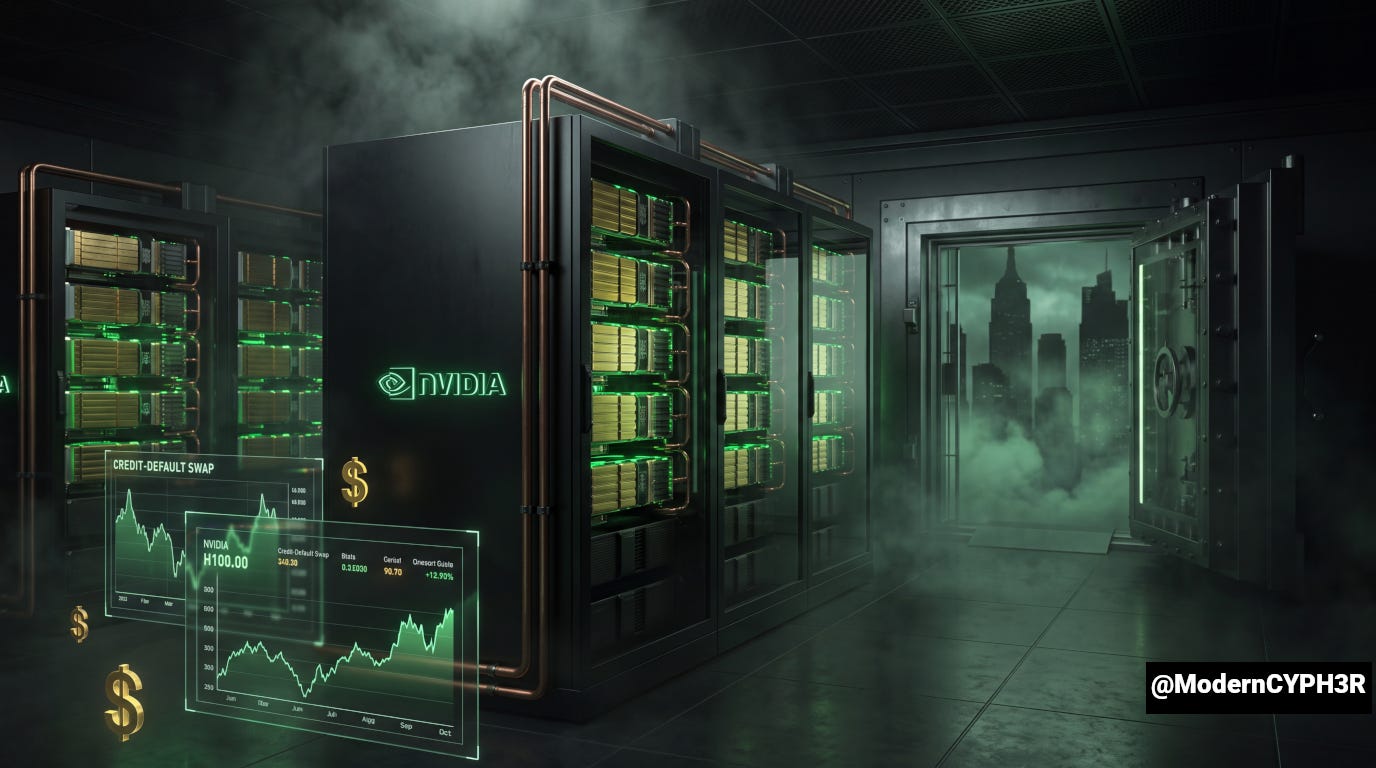
This $500 billion announcement is the ultimate confession that the circular vendor-financing loop is running out of organic capital, and it proves every single assertion I’ve laid out in the “Compute Cartel” article. I’m probably going to catch hell from the AI and Nvidia bootlickers, but the facts show themselves if you do the research.
Read “The Compute Cartel: Trillion-Dollar Data Centers and the Great AI CapEx Shell Game”
I’ve analyzed the telemetry of this deal, and the physical-world implications are staggering:
The $125 Billion Co-Sign (The Backstop Confession)
Wall Street isn’t stupid. The six private credit giants (Apollo, Blackstone, BlackRock, Brookfield, Goldman, and KKR) know that GPU silicon has a three-year useful life and is incredibly poor real estate collateral. They flat-out refused to fund this debt binge unless Nvidia absorbed the risk.
By weaponizing its hyper-inflated stock valuation and soaring cash reserves to contractually guarantee a staggering $125B in residual-value debt backstops for Wall Street lenders, Nvidia is effectively co-signing the very private credit loans used to purchase its own silicon, a high-stakes vendor-financing gamble that binds the chipmaker’s core balance sheet directly to the volatile creditworthiness of unprofitable, venture-backed startups.
If a major cloud tenant like CoreWeave or OpenAI defaults, Nvidia is contractually bound to cover up to 25% of the losses. Nvidia isn’t just selling chips; it’s buying its own future revenues with a massive, off-balance-sheet credit card.
This is a direct, high-definition replication of the off-balance-sheet Special Purpose Entities that Enron used to hide its liabilities. Enron deployed entities like Chewco and Raptor to borrow billions from Wall Street banks using Enron’s own highly inflated stock as a backup guarantee. The core corporate balance sheet looked pristine because the debt was hidden in these off-balance-sheet shells, but the moment the assets underperformed and the stock price fell, the guarantees triggered, bringing those multi-billion-dollar shadow liabilities crashing back onto Enron’s primary ledger and imploding the company overnight. By backstopping $125 billion in private credit debt, Nvidia is running the exact same off-balance-sheet shell game, hoping that its hyper-inflated equity currency will keep the shadow debt from ever reaching its primary books.
The Infrastructure Laundering Scheme
Jensen Huang is attempting to pull off a historic linguistic heist by declaring high-performance silicon to be a “traditional, financeable infrastructure asset class” akin to municipal water lines or electrical grids.
This is a complete lie. Real infrastructure assets have a 50-year operating life and yield steady, regulated utility cash flows. A GPU has a 48-month useful life before it’s a worthless, electricity-sucking brick.
But there’s a dark, psychological reason for this labeling. Public pension funds and state retirement systems have strict, conservative regulatory caps on “venture debt” and “speculative corporate loans,” but they have massive, wide-open buckets reserved for “infrastructure.” By wrapping depreciating silicon loans in an “infrastructure” foil, private credit managers can bypass these risk controls and funnel teachers’ and firemen’s retirement capital directly into Nvidia’s hardware order book.
The Cheerleading Echo Chamber (The MBS and Telecom Ghosts)
The response from the Wall Street echo chamber is a study in collective, leverage-induced hysteria.
First, BlackRock’s Larry Fink proudly declared that this project is the start of the “next future for financial engineering,” specifically comparing it to the creation of mortgage-backed securities in the 1970s. It’s a revealing, highly disturbing Freudian slip. Mortgage-backed securities didn’t just package capital; they created the exact structural plumbing that allowed Wall Street to launder subprime credit risk into AAA-rated public portfolios, eventually imploding the global banking system in 2008. If your marketing pitch is that you’ve figured out how to package high-risk, depreciating tech debt exactly like the instruments that triggered the Great Recession, you’re not advertising innovation; you’re advertising a crime scene.
Second, sycophantic commentators are already claiming you can now “underwrite the infrastructure itself, not the customer,” arguing that Nvidia’s “AI factories” are just like toll roads or bridges. This is a massive economic delusion. If the customer goes bankrupt because their underlying AI software has zero positive unit economics, nobody is paying to run queries on those specific chips. Unlike a physical toll road, which remains useful regardless of which individual trucking firm goes bankrupt, a specialized AI factory has zero utility if end-users stop paying for its specific, hallucinated outputs. You can’t underwrite a factory that has no profitable buyers.
Finally, a tiny handful of sane voices are pointing out the obvious late-90s telecom parallels. During that bubble, hardware giants like Lucent, Nortel, and Cisco lent tens of billions of dollars directly to pre-revenue telecom startups to buy their fiber-optic and switching equipment, booking massive artificial hardware sales on paper until those startups defaulted, collapsing the manufacturers’ credit and triggering a multi-trillion-dollar wipeout. We’re watching the exact same playbook, scaled up to a half-trillion dollars, with private credit acting as the balance sheet of the bubble.
The Music is Speeding Up
If the demand for AI compute were organic and highly profitable, enterprises would be paying for it out of free cash flow, and cloud builders could secure traditional bank loans without requiring the chip manufacturer to co-sign the lease.
This massive $500 billion vehicle isn’t a sign of strength; it’s a frantic effort to keep the cash circulating before the first major wave of 2024–2025 enterprise pilots hit the hard renewal wall. They’re building a half-trillion-dollar life support machine for a bubble that can’t breathe on its own.
Sources & Citations
CNBC Coverage on NVIDIA Wall Street Financing Push:
Title: Nvidia lines up $500 billion in financing as CEO Jensen Huang tells CNBC his chips are ‘investable asset’ (August 11, 2026)
Verified Reference Link: cnb.cx/4zeMXzK
Financial Times Coverage:
Title: Wall Street giants partner with Nvidia on $500bn AI financing deal (August 11, 2026)
Verified Reference Link: ft.com/content/98a8fd17-15b6-4f67-9cb4-825722b11348
LinkedIn News & Hype Telemetry:
Topic: Nvidia lines up $500B in AI funding from Wall Street giants
Reference: linkedin.com/news/story/nvidia-lines-up-500b-in-ai-funding-from-wall-street-giants-7484228
Historical Case Study: late-90s Telecom Vendor Financing:
Details: Autopsy of vendor-financing facilities issued by Lucent Technologies, Nortel Networks, and Cisco Systems to pre-revenue Competitive Local Exchange Carriers (CLECs) like Winstar and Teligent.
Reference: Federal Reserve Bank of San Francisco Economic Letter, The Rise and Fall of Telecom Capital Expenditure (2001-2002).
Historical Case Study: Enron Special Purpose Entities (SPEs):
Details: Forensic analysis of the Raptor, Chewco, and LJM2 special purpose vehicles backed by Enron’s own stock guarantees to hide massive balance sheet liabilities.
Reference: US Senate Committee on Governmental Affairs, The Role of the Financial Institutions in the Collapse of Enron (2002).

Copyright © 2017-2026 James McCabe | ModernCYPH3R. All rights reserved.
No part of this publication—including text, original data analysis, or visual assets—may be reproduced, distributed, or transmitted in any form or by any means, including electronic or mechanical methods, without including credit to the author. ModernCYPH3R and ModernCYPH3R.com are the exclusive intellectual property of JMc Associates, LLC.