
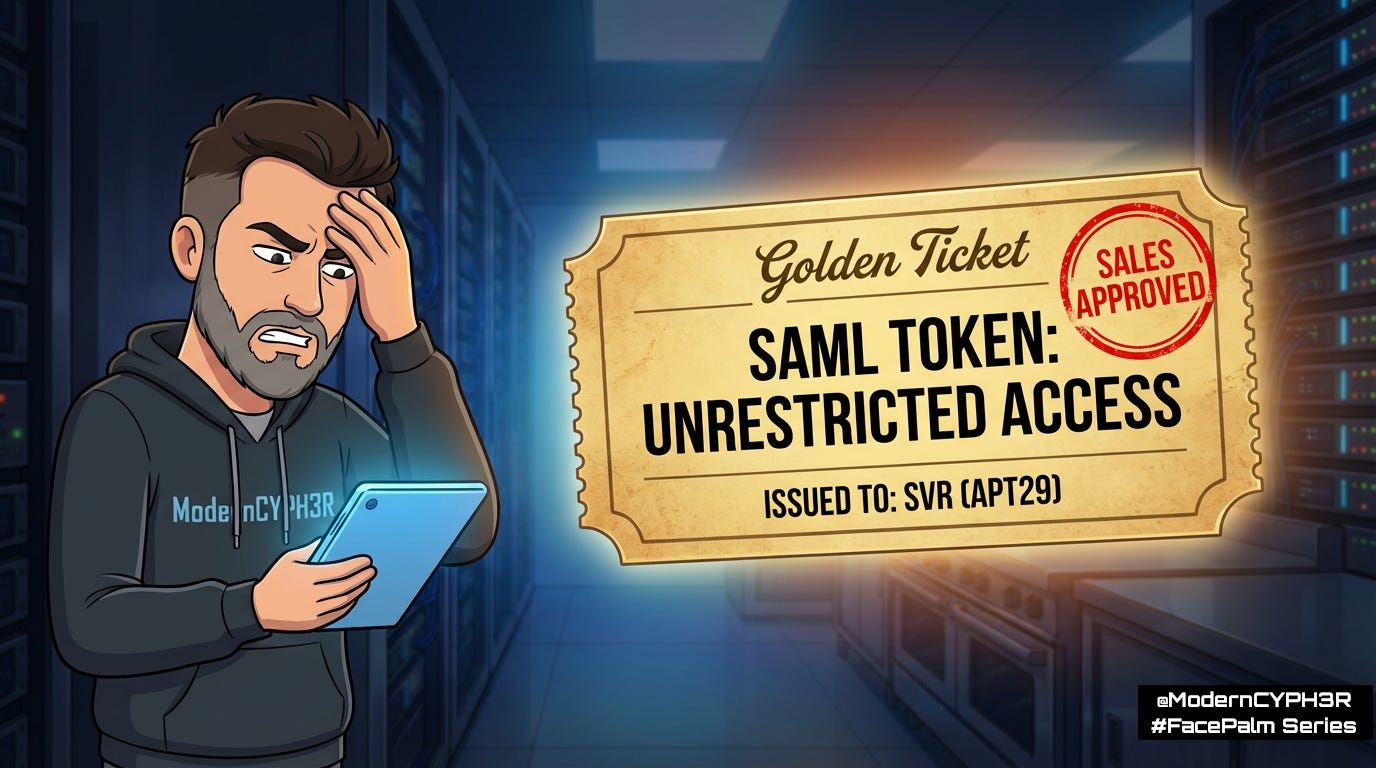
If you’ve ever stayed in a hotel, you know the drill: You get a plastic key card that works about 40% of the time on the first swipe and spends the rest of its life being demagnetized by your smartphone. It’s convenient, frictionless, and—in theory—programmed only for your room.
But imagine you’re a locksmith who discovers a flaw in the hotel’s central server. You realize you can walk into the lobby, tap a few keys, and print a Master Key. Not just a key for the minibar, but a “Golden Ticket” that bypasses the deadbolt, the “Do Not Disturb” sign, and the security guard’s common sense. It’s the skeleton key to the kingdom.
Now, imagine you take this discovery to the hotel manager, and they look at you like you just suggested putting pineapple on pizza. They whisper: “Shhh. We’re in the middle of a $10 billion merger with the Pentagon. If we tell them our master keys are as secure as a screen door on a submarine, they’re going to stay at the Hyatt. Just put the key in your pocket, walk away, and try to look like you aren’t holding a national security crisis.”
Welcome to the Microsoft Golden SAML saga—a masterclass in what happens when a company’s Sales Architecture decides to take its Security Architecture out behind the woodshed.
For four years, Microsoft allegedly sat on a “Logic Fail” that effectively turned the front door of the U.S. Federal Government into a “Take a Penny, Leave a Penny” tray. While their marketing team was busy selling the “Zero Trust” dream, their engineering team was reportedly being told to ignore a fundamental flaw in how the world’s most powerful entities prove they aren’t Russian spies.
This isn’t just another data breach. This is a forensic look at the Physics of the Golden Ticket, the whistleblower who tried to scream over the noise of a $10 billion contract, and why—in the world of Quantum Cybersecurity—a system is only “secure” until the sales team realizes it might affect their year-end bonus.
Grab your coffee. We’re going deep into the XML signatures of a nightmare.
The Physics of the Golden Ticket: How to Forge a God-Key
To understand why this is a #FridayFacepalm, we have to look at the “SAML Physics” that Microsoft claimed was a “feature” rather than a bug.
SAML (Security Assertion Markup Language) is the “Digital Passport” of the modern web. When you try to log into a cloud service like Office 365 or AWS, you don’t actually give them your password. That would be too simple. Instead, the service asks an Identity Provider (IdP)—in this case, Microsoft’s ADFS—to vouch for you.
The IdP checks your ID, does a little digital dance, and hands you a signed “Token.” You take that token back to the cloud service and say, “Microsoft says I’m cool.” The cloud service checks the digital signature on that token and lets you in.
Back in 2016, most of the world was in a messy transition. Big organizations (like the U.S. Treasury) had their “Identity” stored on local servers running ADFS (Active Directory Federation Services), but they wanted to use cloud tools like Office 365. To make this work, Microsoft built a bridge.
The Handshake: When you tried to log into the cloud, Azure AD (the cloud gatekeeper) wouldn’t ask for your password. Instead, it would redirect you back to your local ADFS server. Your local server would verify you were “Bob from Accounting,” sign a digital “Passport” (a SAML Token), and send you back to the cloud. Azure AD would see that digital signature and say, “Microsoft ADFS signed this, so I trust it. Welcome in, Bob.”
The Logic Fail: The “Golden SAML” attack is the ultimate “I am the Captain now” move. To forge the signature on that digital passport, you need the Private Token-Signing Certificate. This certificate is the “Holy Grail” of the ADFS server. It’s the official seal that tells the cloud, “This message is authentic.”
Andrew Harris discovered that if a hacker gained administrative access to that local ADFS server, they could export that private certificate. Once they had it, they didn’t need the server anymore. They could sit in a basement in St. Petersburg, fire up a laptop, and forge their own passports.
The “God-Key” Mechanic: Because the hacker now owns the “Seal of Trust,” they can create a token for anyone. They can tell Azure AD they are the Secretary of the Treasury, a Global Admin, or the person in charge of nuclear launch codes.
And here is the kicker: Azure AD (the Cloud) is a trusting soul. It sees a token signed with the correct “Golden” certificate and it doesn’t ask questions. It doesn’t check back with the local server to see if Bob actually logged in. It doesn’t trigger Multi-Factor Authentication (MFA), because the token says “MFA has already been completed by the local server.” It’s the perfect crime. To the cloud, you look like a legitimate user. To the local server, nothing happened because you never actually talked to it.
Microsoft’s internal stance for years was that this wasn’t a “vulnerability” because the hacker had to already be an admin on the local ADFS server to steal the key. In Architect terms, that’s like saying, “The vault isn’t insecure; you just have to make sure no one ever enters the bank.” It ignored the reality of Lateral Movement—the bread and butter of state-sponsored hackers—where “getting into the bank” is just the first fifteen minutes of the movie.
The Whistleblower vs. The $10 Billion JEDI Contract
Andrew Harris wasn’t just some guy with a theory. From 2014 to 2020, he was a Security Architect and Principal Product Manager at Microsoft. More importantly, he served on the Microsoft Global Incident Response & Recovery team. These are the digital paratroopers Microsoft sends in when a major customer is currently being gutted. Harris didn’t discover the Golden SAML flaw in a vacuum; he saw it in the wild, realizing it was the skeleton key to the kingdom.
When Harris took his findings to the Microsoft Security Response Center (MSRC), he didn’t get a “Hero’s Welcome.” He didn’t even get a vigorous debate. Instead, he hit a wall of Corporate Inertia.
The MSRC’s official stance was that this wasn’t a “vulnerability” because it didn’t cross a “Security Boundary.” In Microsoft-speak, that’s the ultimate bureaucratic trap door—a way of saying, “If the house is already on fire, we don’t care if the front door is made of gasoline.” Their logic was that because a hacker already needed local admin access to steal the certificate, the flaw was the customer’s problem, not theirs.
The "Cloud-First" Collision
But the real rejection didn't happen in the server room; it happened in the boardroom. Harris escalated the issue to senior leaders, including Alex Simons (Director of Program Management). According to the ProPublica investigation, Harris was told that acknowledging the flaw would shake customer confidence at the exact moment Microsoft was chasing the JEDI (Joint Enterprise Defense Infrastructure) contract—a $10 billion winner-take-all prize from the Pentagon.
The Facepalm
Harris’s proposed fix would have required customers to disable a feature called “Seamless Single Sign-On (SSO).” For Microsoft, that was a non-starter. Disabling “Frictionless” features makes for a bad sales pitch. So, they made a calculated decision: they chose Frictionless Sales over Structural Security. They didn’t just “miss” the bug; they relegated it to the “Won’t Fix” pile to protect the ARR (Annual Recurring Revenue). In Architect terms, this is like a lead engineer discovering the foundation of a skyscraper is made of wet cardboard, but the CEO deciding to keep quiet because the ribbon-cutting ceremony is next week and the catering has already been paid for.
While Harris was pleading for a fix, Microsoft was busy polishing the “Zero Trust” marketing materials. It’s the ultimate Security Theater: selling the world a high-tech biometric alarm system while knowing the backdoor key is taped to the underside of the mailbox.
The SVR Autopsy (When the "Feature" Hits the Fan)
In the cybersecurity world, there is a distinct difference between a “PoC” (Proof of Concept) and a “Body Count.” For four years, Microsoft treated Harris’s warning as an academic exercise. But in 2020, the SVR (Russian Foreign Intelligence Service) decided to show them what a “Security Boundary” actually looks like.
The SolarWinds Pivot The SVR (tracked as APT29 or Cozy Bear) didn’t just hack a software company; they hacked a Supply Chain. But even a supply chain breach only gets you into the lobby. To get into the vault—the U.S. Treasury, the Department of Commerce, and the National Nuclear Security Administration—they needed the God-Key. They used the exact “Logic Fail” Harris had spent his tenure trying to fix.
According to the CISA Alert AA21-008A, the SVR followed Harris’s “rejected” playbook with surgical precision:
Initial Access: They used the SolarWinds backdoor to gain a foothold on local networks.
Privilege Escalation: They moved laterally until they reached the ADFS server.
The Theft: They stole the Private Token-Signing Certificate—the “Master Seal.”
The Forgery: They printed Golden SAML tokens and handed them to Azure AD.
The Damage Report
Because the SVR now owned the “Seal of Trust,” they looked like perfectly legitimate officials. They didn’t need to steal passwords or bypass MFA. The “Golden Ticket” told the cloud that MFA was already done. The cloud didn’t just let them in; it held the door open while they vacuumed up:
Emails from the highest-ranking officials at the U.S. Treasury.
Sensitive research from the National Institutes of Health (NIH).
Data from the National Nuclear Security Administration (NNSA)—the people who literally look after our nuclear weapons stockpile.
While Microsoft maintains that “no Microsoft vulnerability was involved,” the reality is that they left a master key under the mat because fixing the lock was “too expensive for the brand.” Microsoft spent years chasing the JEDI contract to prove they were the “Secure Choice” for the military, all while leaving a backdoor open that allowed the very adversaries we’re defending against to waltz into our nuclear secrets.
The Corporate Gaslight (Brad Smith’s Quantum Testimony)
In February 2021, Microsoft President Brad Smith sat before the House Homeland Security and Oversight Committees. He was there to explain how a Russian intelligence agency had spent months rummaging through the U.S. government’s most sensitive files like they were looking for a spare set of AA batteries.
This is where we entered the era of Quantum Cybersecurity: a state where a system is simultaneously “Secure” and “Compromised” until a PR rep observes it and issues a press release.
The “Technically Correct” Trap Smith told Congress, “There was no vulnerability in any Microsoft product that was exploited.” To an Architect, this is a masterclass in linguistic gymnastics. Microsoft’s defense rested on a very specific, very narrow definition of “vulnerability.” In their view:
ADFS was working exactly as designed (it’s supposed to sign tokens).
Azure AD was working exactly as designed (it’s supposed to trust signed tokens).
Therefore, the “exploit” was just a customer having their certificate stolen—essentially a “configuration issue.”
This is like a car manufacturer saying, “The car didn’t fail. It was designed to explode if you hit a pothole. The fact that you hit a pothole is a ‘road configuration’ issue.” By refusing to acknowledge Golden SAML as a product flaw, Microsoft successfully shifted the blame onto the victims. They ignored the fact that Andrew Harris had given them the “fire extinguisher” years earlier and they had opted to leave it in the warehouse because it clashed with the lobby’s aesthetic.
The “Identity Security” Paradox
While Smith was testifying about how secure their systems were, Microsoft was simultaneously using the breach as a massive marketing opportunity. Their message to customers was: “See? On-premise servers (ADFS) are dangerous! You need to move everything into our cloud (Entra ID) and upgrade to our ‘E5’ premium security tier to be truly safe.”
In the business world, this is called “Creating the problem and selling the solution.” They left the screen door unlocked on the old house, and when the burglars walked in, they used it as a reason to convince everyone to move into their new, more expensive apartment complex.
The CSRB Autopsy (The 2024 Reality Check)
If this story ended in 2021, Microsoft might have gotten away with the “No Vulnerability” defense. But the “Logic Fail” was too big to bury forever.
In April 2024, the Cyber Safety Review Board (CSRB)—an independent body appointed by the Biden administration—issued a report that read less like a government document and more like a forensic roasting. They looked at Microsoft’s recent string of disasters (including the 2023 China-linked hack of U.S. State Department emails) and reached a scathing conclusion.
The Audit Results:
Culture Failure: The board stated that Microsoft’s security culture was “inadequate” and required an overhaul.
Avoidable Errors: They cited a “cascade of avoidable errors” that allowed state-sponsored hackers to roam free.
Prioritizing Features over Security: The report validated everything Andrew Harris had been saying since 2016. It proved that the “Golden SAML” era wasn’t a one-off mistake; it was a symptom of a systemic choice to prioritize speed and sales over safety and architecture.
The ModernCYPH3R Audit: Trust is binary. You either have a secure architecture, or you have Security Theater. When the world’s largest software company spends four years gaslighting its own architects to protect a $10 billion contract, they aren’t just failing a security audit—they are failing the fundamental “Logic Test” of digital trust.
In the end, the SVR didn’t need a “Quantum Computer” to break our national security. They just needed a Microsoft leadership team that was too busy looking at a spreadsheet to notice someone was printing Master Keys in the lobby.
The lesson of the Golden SAML isn’t just “patch your servers.” It’s that we are training the world to ignore the boy who cried “Logic Fail.” When the systems behind our security alerts are governed by quarterly earnings rather than architectural integrity, the alerts become background noise.
And when the “wolf” finally shows up? He’s usually wearing a suit, carrying a “Golden Ticket,” and being let in through the front door by a company that told you everything was fine.
Pro-Tip: If your internal security expert tells you the foundation is made of wet cardboard, believe them—even if the Sales Team has already ordered the champagne for the ribbon-cutting.
In the meantime, if you find yourself spiraling over “Quantum Security” and forged passports, do what I do: Find a mechanical lock. Go to your front door and turn a physical deadbolt. There is something profoundly honest about a piece of brass that doesn’t care about quarterly earnings, doesn’t need to “sync” with a cloud gatekeeper, and doesn’t accept forged XML signatures.
A physical key only works if the person holding it actually has the key. In a world of “Golden” tokens and digital theater, sometimes the most high-tech thing you can do is rely on something that’s been unhackable since the Bronze Age.
#FridayFacepalm #ModernCYPH3R #Microsoft #SolarWinds #GoldenSAML #LogicFail #Cybersecurity
ModernCYPH3R’s Bibliography: Evidence & Technical Deep-Dives
For those who want to audit the auditors, here is the paper trail for the Golden SAML logic fail:
The ProPublica Investigation: Microsoft Was Warned of a Flaw That Russian Hackers Later Used to Breach the Federal Government — The definitive investigative report on Andrew Harris and the internal pushback at Microsoft.
CISA Alert (AA21-008A): Detecting Post-Compromise Threat Activity in Microsoft Cloud Environments — The technical autopsy of how the SVR moved from on-premise ADFS servers to the Azure cloud.
The Original “Golden SAML” Research (CyberArk): Golden SAML: How to Become a God in Your Cloud Environment — The 2017 technical proof-of-concept by Shaked Reiner that Microsoft initially dismissed as a “configuration issue.”
The CSRB Report (April 2024): Report on the Microsoft Online Exchange Breach — The Cyber Safety Review Board’s scathing audit of Microsoft’s “inadequate” security culture and “avoidable errors.”
Congressional Testimony: The SolarWinds Cyberattack: Demanding Accountability — Search for the February 2021 testimony of Brad Smith for the “no vulnerability” quotes referenced in this article.
Microsoft’s Official ADFS Guidance: Best Practices for Securing Active Directory Federation Services — The document where Microsoft eventually admitted that if you lose your token-signing certificate, the “security boundary” is effectively gone.