
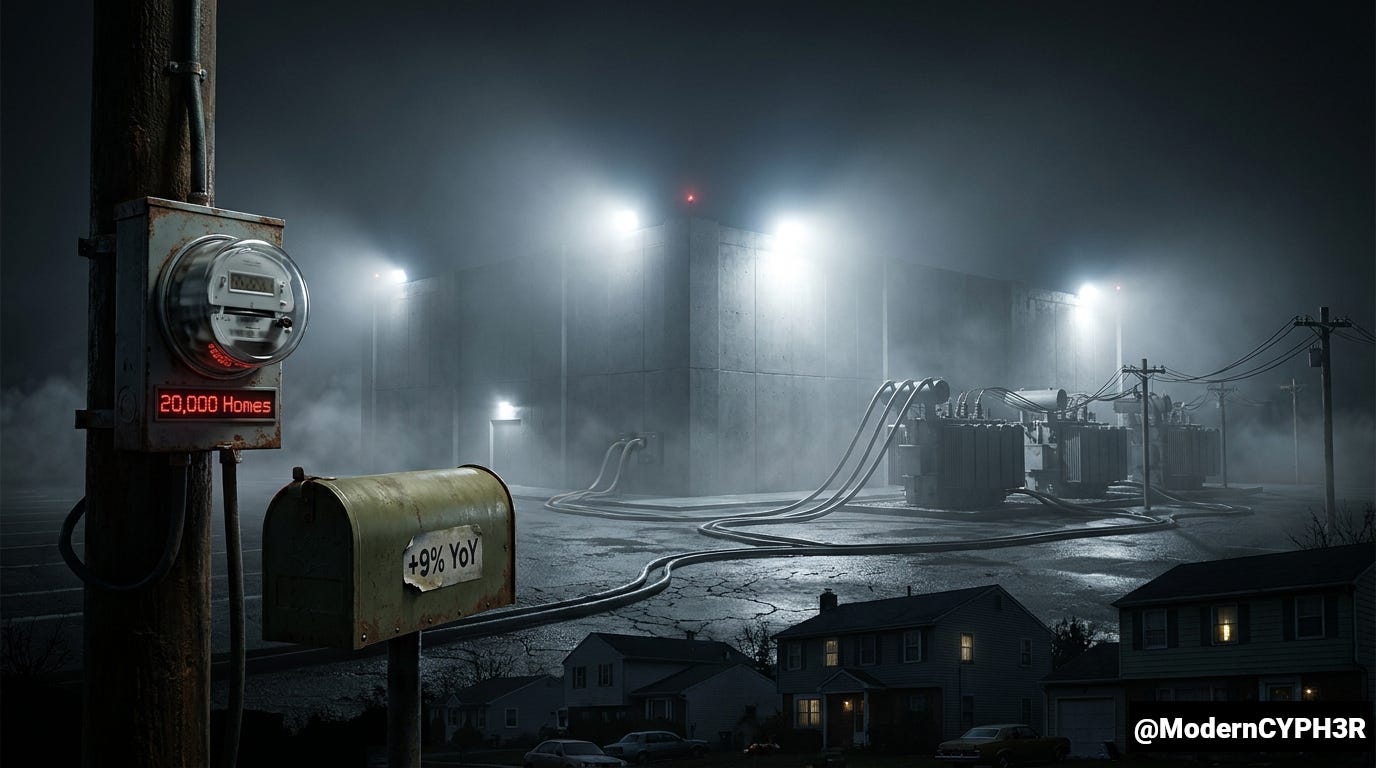
Author’s Note: Welcome to The Concrete Parasite, a four-part forensic breakdown of how hyperscale AI data centers are physically breaking our municipal infrastructure, and the exact architectural mandates we need to stop them. Stay turned for part 2-4 coming up shortly.
The Concrete Parasite Series Index:
[Part 1: The Dystopian Subsidy] - Why the “Cloud” is actually a heavy concrete box draining the equivalent of 20,000 homes from your local power grid.
[Part 2: The Thermal Cop-Out] - How tech giants boil millions of gallons of your drinking water to cool their servers, and why we must mandate dielectric fluid immersion.
[Part 3: Bring Your Own Power] - The case for forcing hyperscalers off the public grid via Small Modular Reactors (SMRs) and solid-oxide fuel cells.
[Part 4: The Policy Hammer] - An open-source legislative blueprint and letter template to force your local zoning board into a moratorium.
If you listen to the marketing executives in Silicon Valley, “The Cloud” is an ethereal, weightless concept. It’s a magical realm of infinite storage and seamless compute power that floats above our daily lives, gently dropping AI-generated email responses and streaming video directly into our pockets.
I live in Loudoun County, Virginia. And I can assure you, the cloud isn’t floating anywhere.
The cloud is a heavy, thirsty, windowless concrete box. And it’s currently draining my local reservoir and hijacking my electrical grid.
Loudoun County is “Data Center Alley.” Over 70% of the world’s internet traffic routes through the endless sprawl of grey monoliths sitting in my backyard. Driving around here at night is like navigating a dystopian scene out of Blade Runner. Eerie, bright security lights shine down miles of sterile cement walls, protecting the beating heart of the modern digital economy.
It looks futuristic, but structurally, it’s a massive, localized logic fail. We’re currently watching hyperscale tech giants socialize the massive physical costs of their infrastructure while privatizing the historic profits.
And you’re the one subsidizing it.
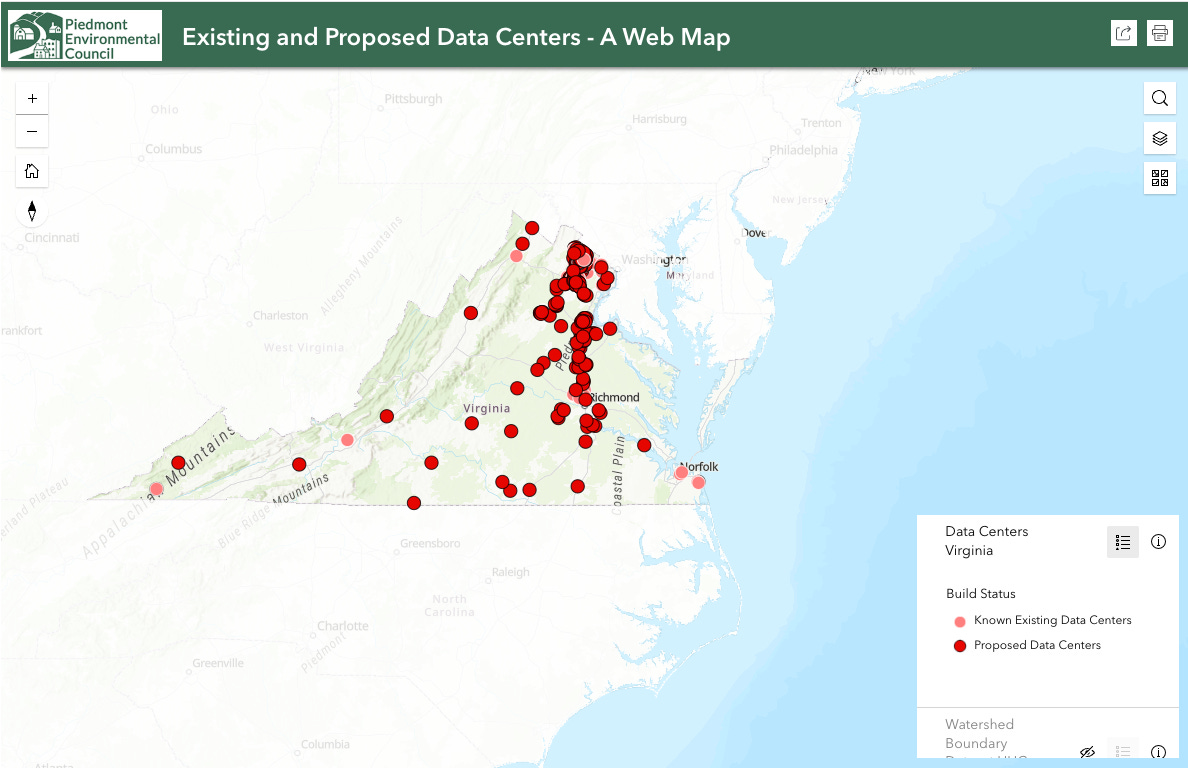
Here’s a map of current and proposed datacenters throughout VA. You can reach the interactive map here: https://www.pecva.org/region/loudoun/existing-and-proposed-data-centers-a-web-map/
The Mathematical Reality of the Hyperscale Drain
Let’s strip away the “Agentic AI” buzzwords and talk about thermodynamics and physics. AI isn’t just software; it’s a brutally physical manifestation of hardware. Training a Large Language Model requires tens of thousands of GPUs packed into high-density racks. A standard corporate server rack might draw 5 to 10 kilowatts of power. An AI server rack easily draws 40 to 100 kilowatts.
When a local zoning board, a group of people used to approving minor traffic lights and strip mall additions, approves a new million-square-foot data center campus, they aren’t just approving a building.
They’re approving the power consumption equivalent of 20,000 residential homes.
Read that again. Every time one of these massive concrete bunkers powers up, it pulls the equivalent of a medium-sized town off the local grid.
Our electrical grids were built in the 1950s and 60s. They were designed for the rhythmic, predictable consumption of human behavior—power usage spikes when people wake up and turn on the coffee maker, spikes again when they get home and run the AC, and drops to a baseline hum while everyone sleeps.
Hyperscale data centers don’t sleep. They demand a relentless, flat-line, 24/7 power draw that the grid fundamentally cannot handle.
The Dystopian Subsidy
So, what happens when you plug industrial-scale, gigawatt compute facilities into a residential utility grid? The grid breaks, and the utility companies scramble to buy more power (usually by burning more natural gas) and build more substations.
And who pays for that infrastructure upgrade? You do.
Here in Loudoun County, residents are looking at a 9% year-over-year increase in our electric bills, without a single kilowatt-hour increase in personal usage. Our quarterly water bills are following the exact same trajectory (which we’ll cover in Part 2).
This is the “Dystopian Subsidy.” The local taxpayer is footing the bill to ensure Microsoft, Amazon, and Google have enough cheap electricity to train the next generation of AI bots. The hyperscalers have the capital to build their own localized, sustainable power generation. They simply choose not to, because draining the public grid is cheaper.
The Bureaucratic Band-Aid
Politicians are starting to panic, but as usual, their solutions are administrative theater. You’re starting to hear murmurs about imposing a “Data Center Electricity Tax.”
Let me save you the suspense: a tax won’t fix this.
A tax is a bureaucratic band-aid on a physics problem. Trillion-dollar hyperscalers will happily absorb a marginal electricity tax, pass the cost onto their enterprise cloud customers, and continue draining the grid until the transformers catch fire. You don’t solve a thermodynamic limit by throwing accounting tricks at it.
You solve an engineering failure with an engineering mandate.
If these companies want to build the future of AI, they need to stop acting like parasites on the 1950s public utility grid. They need to bring their own power.
In Part 2: The Thermal Cop-Out, we’ll look at the other half of the equation: why these facilities are literally boiling millions of gallons of your municipal drinking water into the atmosphere, and the exact architectural mandate we need to stop it.
Citations:
• Official Legislative Audit: Virginia Electric Utility Regulation Act Status Report (RD716) https://rga.lis.virginia.gov/Published/2025/RD716/PDF (The definitive
October 31, 2025 SCC report to the General Assembly mapping out the exact billing riders and capital recovery mechanics for grid expansion).
• Piedmont Environmental Council: PEC Data Center Hub https://www.pecva.org/datacenters (Verifies peak energy equivalents of 15,000+ homes and the infrastructure cost
shift to locals).
• State Corporation Commission Docket: Virginia SCC Case Search Portal https://scc.virginia.gov/case-information (Search Case PUR-2025-00058 for the November 25, 2025
Order establishing the “GS-5” rate class for data centers above 25 MW).
• Virginia Grid Advocacy: Virginia Conservation Network https://vcnva.org/ (Tracks regional gigawatt growth and baseline reliability threats).

Copyright © 2017-2026 James McCabe | ModernCYPH3R. All rights reserved.
No part of this publication—including text, original data analysis, or visual assets—may be reproduced, distributed, or transmitted in any form or by any means, including electronic or mechanical methods, without including credit to the author. ModernCYPH3R and ModernCYPH3R.com are the exclusive intellectual property of JMc Associates, LLC.