
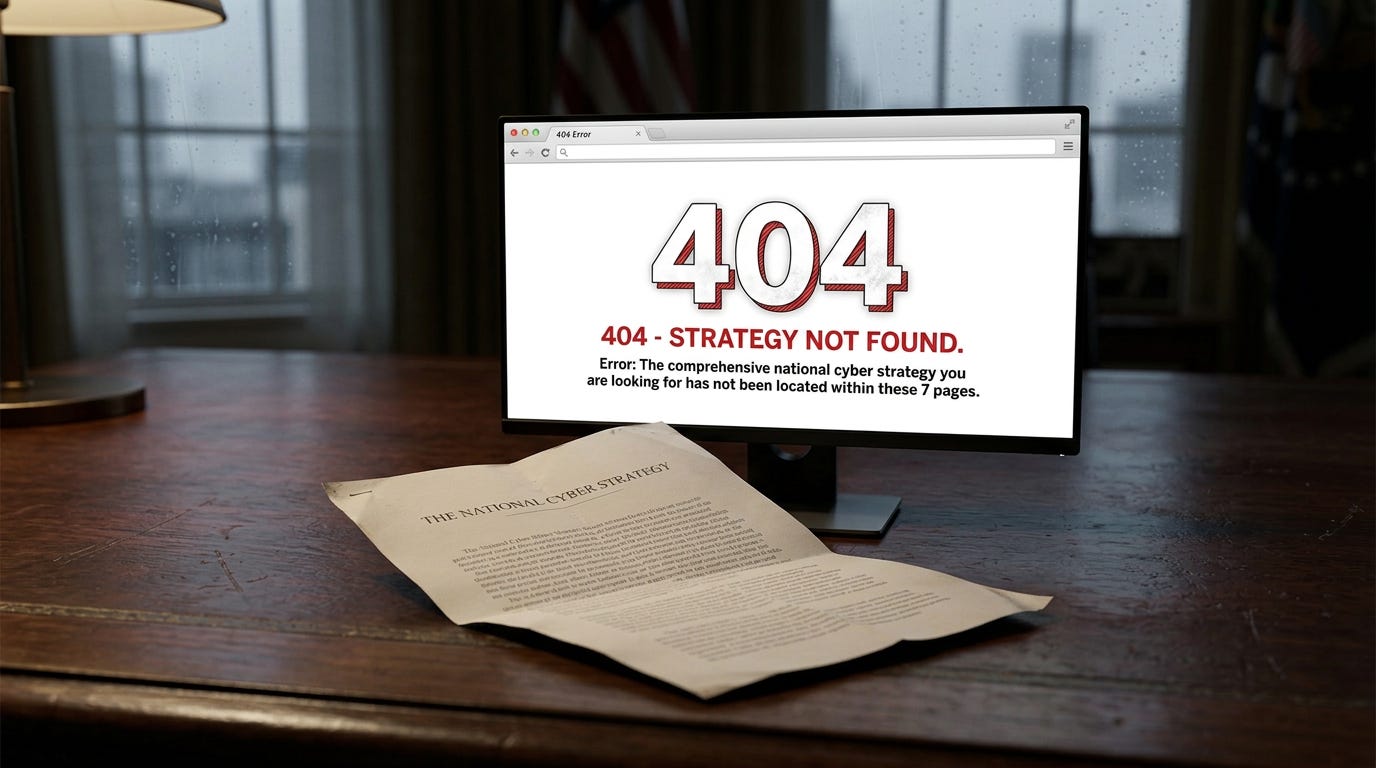
The White House just dropped a “National Cyber Strategy” for March 2026, and I’ve written longer setup guides for a home mesh Wi-Fi system. Calling seven pages a “National Strategy” for the entire digital infrastructure of the United States is like trying to explain the complexities of global logistics by pointing at a UPS truck. You’ve got the general idea that packages move, but you’re in for a shock when the sorting facility loses power.
We are deep in a “maintenance-only” mindset here. For decades, we’ve treated security like a high-stakes game of digital Whac-A-Mole, frantically slapping patches over holes in a perimeter that hasn’t existed since everyone started working from their kitchen tables. We’ve spent billions on “zombie boxes”—those blinking racks of firewalls that are currently just expensive space heaters because they can’t see into encrypted traffic to save their lives.
Instead of admitting that the old physics of the network is dead, we’ve just shortened the brochure.
The strategy pivots to “Offensive Deterrence” and “Shaping Adversary Behavior”. It sounds impressive, like installing a high-tech alarm system, but in the world of packets, “deterrence” is mostly a psychological comfort blanket. An adversary doesn’t stop a logic bomb because they read a sternly worded PDF; they stop when the network itself makes the attack as impossible as trying to stream 4K video over a dial-up modem.
It’s the classic human desire to fix a structural foundation crack by buying a louder “No Trespassing” sign. We’re ditching “costly checklists,” which were mostly just us lying to ourselves anyway—and replacing them with a “vibe shift” toward being aggressive. But you can’t “deter” a scripted botnet with a press release when your own back door is a rusted remote-access gateway that hasn’t seen an update since the Obama era.
We’re addicted to the marketing of “being secure.” It’s much easier to tell a board of directors we’re “taking the fight to them” than it is to admit we’ve been pouring money into a legacy architecture that is fundamentally broken.
The 30,000-Foot Blueprint: What a Real Strategy Requires
If your national strategy fits on a diner menu, you aren’t fixing the plumbing; you’re just ordering another round of the same delusions and hoping the bill doesn’t come due during your shift. A functional architecture for a digital nation should prioritize these four pillars:
Hardening the “Blast Radius”: Instead of just “modernizing” federal systems with more expensive licenses, we must focus on compartmentalization. A real strategy assumes the breach has already happened and ensures a compromised legacy printer doesn’t provide a lateral path to the power grid or the Treasury.
Radical Supply Chain Transparency: We talk about “securing supply chains”, but we’re still buying black-box software with hidden dependencies. A legitimate strategy mandates a “Software Bill of Materials” (SBOM) for critical infrastructure—if you don’t know every library running in your water treatment plant, you don’t own your security.
Incentivizing Resilience over Compliance: “Streamlining regulations” shouldn’t mean making it easier to check a box. We need to pivot to a model where organizations are rewarded for verifiable resilience—the speed of recovery from a total wipe —rather than how many binders of “policy” they can produce for an auditor.
Authenticity at the Edge: In an era of agentic AI and deepfakes, we must stop trying to “detect” lies and start “verifying” truth. This requires robust, cryptographically verified identity standards at the source. If we can’t trust the source of a command, the speed of “AI-powered solutions” just means we’re failing faster.
The Real Call to Reality:
A seven-page document is a press release; a strategy is a blueprint. We need to stop focusing on "shaping adversary behavior"—which assumes the threat is a rational actor—and start shaping our own infrastructure so that the threat's capability becomes irrelevant. You can’t "deter" an algorithm; you can only deny it the exploit. If your security relies on the adversary deciding not to push the button, your architecture has already failed.
Bibliography
* Executive Office of the President. (2026, March). President Trump’s Cyber Strategy for America. The White House.